How Pakistani Dentists Can Become Licensed Dentists in the USA
A comprehensive month-by-month roadmap for BDS graduates transitioning to U.S. clinical practice.
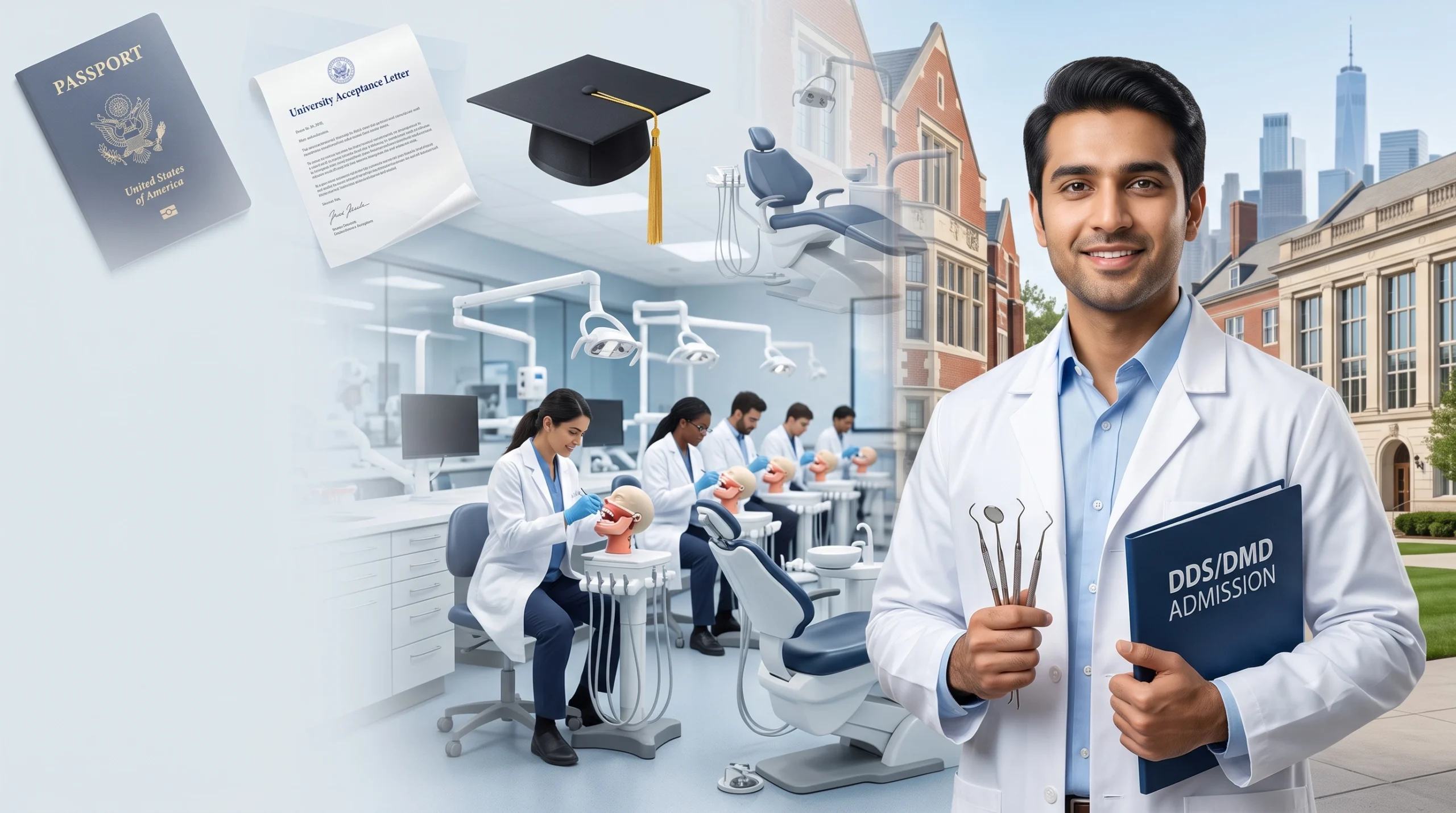
Can a Pakistani dentist become a licensed dentist in the USA? Yes. Pakistani dentists can become licensed in the United States, but a BDS degree alone is not enough. Most state boards require graduation from a CODA-accredited dental program.
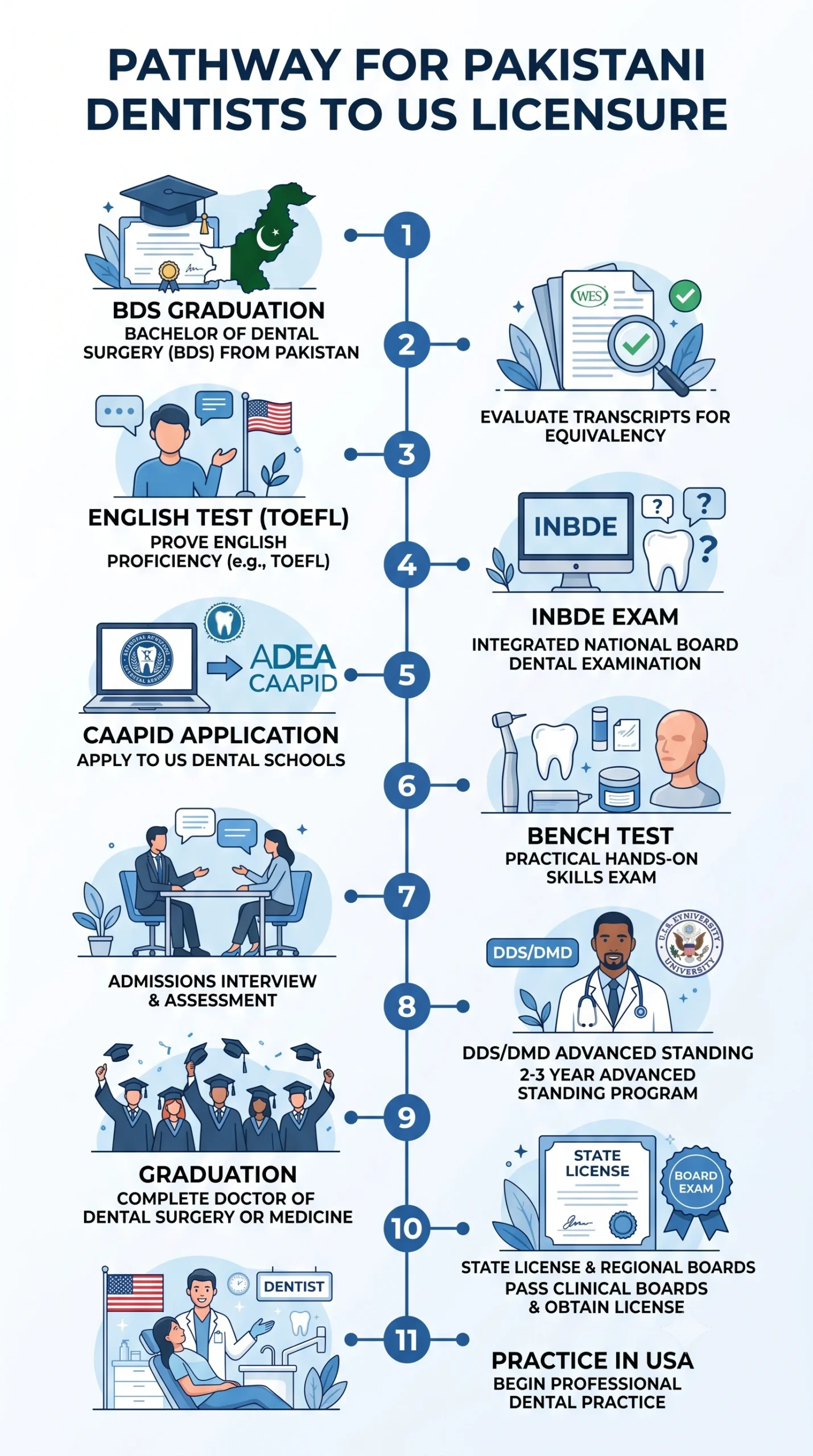
Pakistani-trained dentists typically complete credential evaluation, pass the INBDE, apply through ADEA CAAPID, gain admission into an advanced standing DDS or DMD program, finish clinical training, and meet state-specific licensing requirements. The pathway usually takes 3 to 6 years.
3-6 Yrs
Total Licensure Process
2-3 Yrs
Advanced Standing Coursework
March 5
CAAPID Cycle Opens
The Real Pain Point for International Dentists
Most Pakistani BDS graduates don’t fail because they lack clinical skill. They stall because the U.S. system is fragmented. One exam board (JCNDE) handles the INBDE, a separate service (ADEA CAAPID) handles applications, individual state boards set licensing rules, and each dental school sets its own admission bar. This guide exists to coordinate this pipeline.
Quick Solution Overview
Here is the entire pathway compressed into one action checklist:
- Get your BDS transcripts evaluated by ECE (course-by-course report)
- Take TOEFL or IELTS (check school minimums)
- Create a DENTPIN
- Register for and pass the INBDE
- Create an ADEA CAAPID profile and apply to advanced standing programs
- Prepare a personal statement, CV, and letters of recommendation
- Complete school interviews and Bench Tests
- Enroll in a 2–3 year Advanced Standing DDS/DMD program
- Apply for an F-1 student visa
- Graduate and pass your state’s required clinical licensing exam
- Apply for state licensure and begin practicing
College Essay Examples for Study Abroad Applications
Whether you’re applying to an undergraduate program, a U.S. dental school, or an advanced standing track, the personal statement is often the single biggest differentiator between two applicants with comparable test scores.
Why Essays Matter
Your GPA and INBDE score prove you can do the work. Your essay proves why you should be chosen. Admissions committees use it to judge communication skills, motivation, and maturity.
Common Mistakes in Essays
- Restating the resume instead of explaining motivation.
- Generic openings (“Ever since I was a child, I have wanted to be a dentist…”).
- No specific mention of the target school or program.
- Overly formal, thesaurus-heavy language.
Sample Essay Frameworks
Sample Introduction (Strong):
“The first time I placed a composite restoration without supervision, I noticed something my professors hadn’t mentioned: how much of dentistry is really about reading a patient’s fear before you ever pick up an instrument.”
Sample Introduction (Weak):
“I have always been passionate about helping people and believe dentistry is the perfect career for me.”
Sample Conclusion (Strong):
“An advanced standing program won’t just certify what I already know — it will teach me to practice dentistry inside a system built around patient autonomy and continuous evidence review, which is exactly the standard I want to hold myself to for the next thirty years.”
Sample Conclusion (Weak):
“In conclusion, I am confident that I will be a great addition to your program and look forward to a successful career in dentistry.”
Med School & Dental School Application Timeline
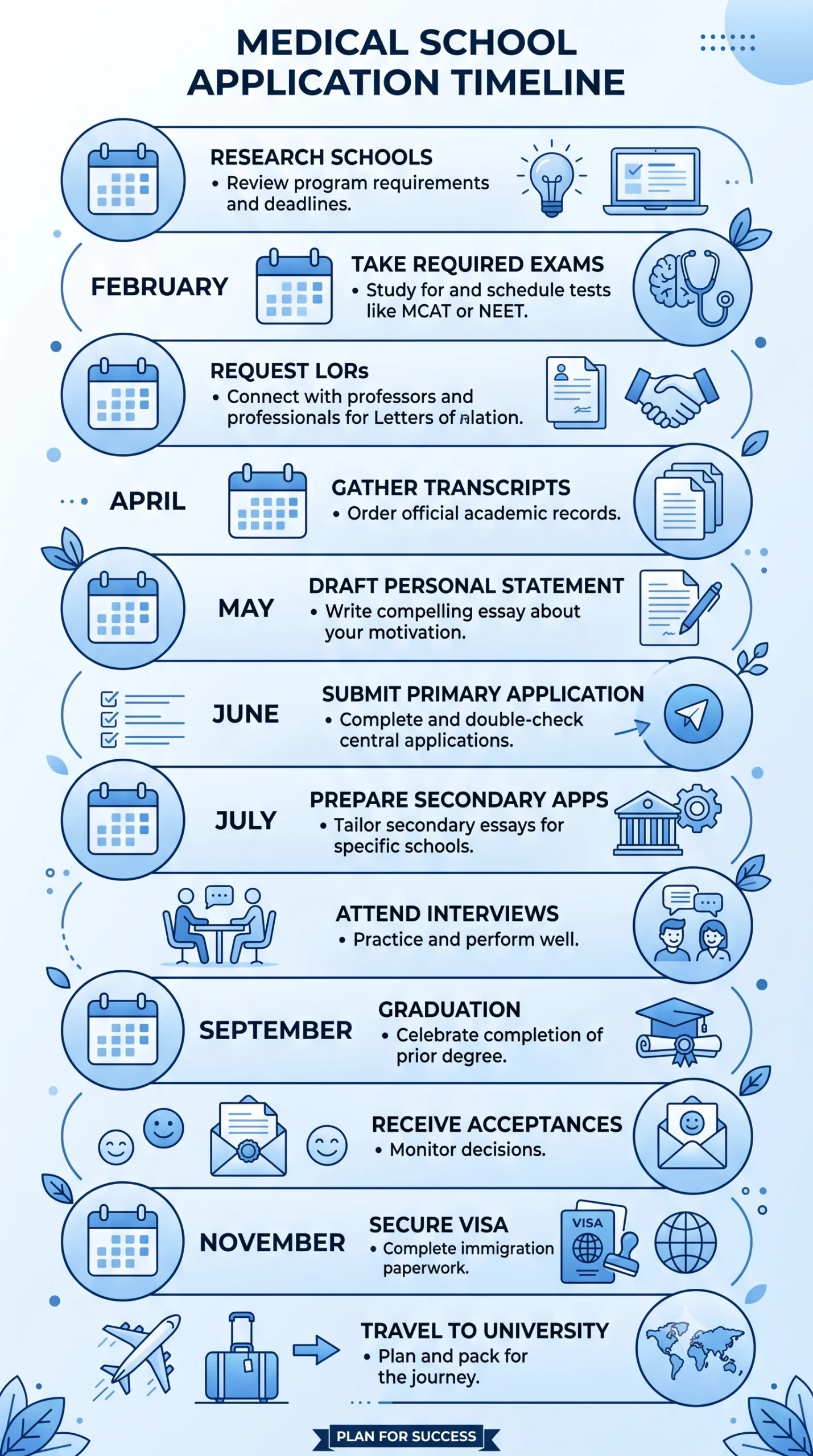
Working backward from the application deadline is key. Below is a realistic month-by-month timeline for a Pakistani BDS graduate targeting advanced standing dental programs.
| Month | Milestone | Notes |
|---|---|---|
| Month 1–2 | Research schools & CAAPID-participating programs | Use the CAAPID Program Finder to shortlist. |
| Month 2–3 | Order ECE course-by-course credential evaluation | Takes 2–5 weeks once documents are submitted. |
| Month 2–4 | TOEFL/IELTS preparation and test | Check target school minimum scores. |
| Month 3–4 | Create DENTPIN and register for INBDE | Allow 3–6 months of prep time. |
| Month 4–7 | Take and pass the INBDE | Results typically available in 3–4 weeks. |
| Month 5–8 | Draft personal statement, CV, request letters | Start early — letters of recommendation take weeks. |
| Month 6–9 | Submit ADEA CAAPID application | Cycle runs March 5, 2026 – January 29, 2027. |
| Month 8–10 | School interviews and Bench Tests | Prepare separately for each school. |
| Month 10–12 | Admission decisions | Rolling admissions vary by program. |
| Month 11–13 | Apply for F-1 visa | Requires I-20 and SEVIS fee. |
| Month 12–14 | Enrollment begins | Advanced standing programs run 2–3 years. |

How International Students Can Study in the USA
The pathway to U.S. higher education follows a standard structure. Accredited universities offer professional programs, but for licensing, only CODA-accredited programs are eligible.
- Admission Process: Requires transcript evaluations (ECE), English proficiency (TOEFL/IELTS), personal statements, and letters of recommendation.
- Scholarships: Financial aid is limited for professional degrees. Consult official school aid portals.
- Student Visa: Full-time academic students enter on an F-1 visa after obtaining an I-20 and paying the SEVIS fee.
Dental Universities in the USA for International Students
DDS vs. DMD: Doctor of Dental Surgery and Doctor of Dental Medicine are functionally identical degrees. The distinction is in the naming convention of the university.
What “Advanced Standing” Means: Advanced standing programs are accelerated 2-to-3-year curricula designed specifically for internationally-trained dentists, skipping the redundant early clinical years.
How International Dentists Become Licensed in the USA
Step 1: Credential Evaluation
Get a course-by-course evaluation of your BDS credentials from a NACES-member agency (typically ECE).
Step 2: English Proficiency
Pass the TOEFL iBT meeting the minimum score required by your target schools.
Step 3: Create a DENTPIN
Register for your unique identification number through the ADA website.
Step 4: Pass the INBDE
Pass the Integrated National Board Dental Examination (INBDE), which replaced the NBDE Part I & II.
Step 5: Apply via ADEA CAAPID
Submit your profile during the cycle (runs March 5, 2026 to January 29, 2027). Fees: $264 first program, $115 each additional program.
Step 6: School Interviews & Bench Tests
Showcase your practical hand skills (restorations, preparations) and clinical reasoning.
Step 7: Advanced Standing Program & State Licensure
Graduate from the 2-3 year program and pass your target state’s clinical board exam (ADEX, WREB-CITA, etc.).
Licensure Myths vs. Facts
| Myth | Fact |
|---|---|
| A BDS from Pakistan is enough to practice in the U.S. | Most states require a CODA-accredited DDS/DMD. |
| INBDE and NBDE are the same exam. | INBDE officially replaced NBDE Part I/II in 2020. |
| Every dental school requires a Bench Test. | Bench Tests are school-specific. |
| All advanced standing programs use CAAPID. | Some programs are non-CAAPID. Always verify. |
| Any state accepts any clinical licensing exam. | Clinical exam acceptance varies significantly by state. |
Cost Breakdown Table
Application & Exam Costs
| Cost Item | Estimated Cost | Notes |
|---|---|---|
| ECE Credential Evaluation | Variable | Course-by-course evaluation required. |
| TOEFL | Variable | Confirm fees on the ETS portal. |
| INBDE Exam Fee | Check Candidate Guide | Fee is published annually by the JCNDE. |
| DENTPIN Registration | Free | Required before booking the test. |
| CAAPID First School | $264 | 2026-27 Application cycle fee. |
| CAAPID Additional School | $115 | Per school fee. |
| F-1 Visa Fees (SEVIS + Visa) | Variable | Set by U.S. Department of State. |
Dental School Tuition Comparison (4-Yr Reference Figures)
*The tuition numbers below are published four-year figures for standard DDS/DMD tracks. Advanced standing tuition is posted separately by each school and may differ. Always confirm advanced-standing-specific costs.
| Dental School | Resident Tuition (4-yr) | Non-Resident/Private Tuition (4-yr) | Note |
|---|---|---|---|
| University of California, San Francisco | $212,070 | $261,050 | Lower-cost public option. |
| University of California, Los Angeles | $231,162 | $280,142 | Moderate public tuition. |
| University of North Carolina, Chapel Hill | $152,273 | $286,445 | Large resident/non-resident gap. |
| University at Buffalo (SUNY) | $154,320 | $267,200 | One of the lower-cost public schools. |
| University of Michigan, Ann Arbor | $222,382 | $303,677 | Top-ranked, mid-range public tuition. |
| Harvard University | $277,200 | $277,200 | Private, flat tuition rate. |
| Tufts University | $378,792 | $378,792 | High-cost private. |
| Boston University | $384,304 | $384,304 | High-cost private. |
| Columbia University | $388,464 | $388,464 | High-cost private. |
| New York University | $411,392 | $411,392 | Among the most expensive. |
| University of Southern California | $437,481 | $437,481 | Highest in this sample. |
Salary After Graduation
Compensation varies by state, practice setting, and experience. Check the current U.S. Bureau of Labor Statistics (BLS) Occupational Outlook Handbook for verified national salary figures. Typical career paths:
- Associate Dentist: Standard entry-level clinical role.
- Private Practice Owner: Highest potential over time, requires business management.
- Specialist: Requires residency training (orthodontics, oral surgery, pedodontics, etc.).
- Academic/Corporate Dentist: Structured work hours and stable benefits.
Frequently Asked Questions
Muhammad
Career Advisor & Contributor at CareerNext.pk.
Explore Other Destinations
Recommended External References
American Dental Association (ADA) | American Dental Education Association (ADEA) | Educational Credential Evaluators (ECE) | U.S. Student Visa Guidance
Connect with CareerNext Pakistan
Get professional career guidance, resume reviews, and study placement guidance at our Karachi head office.
📍 Garden City, Scheme-45, Karachi, Pakistan
View Google Business Profile