
Why the World is Waiting for AI Agent Architects | The 2026 AI Career Roadmap
The ladder is leaning against a building scheduled for demolition. Most people don’t see the wrecking ball yet, but the vibrations are already rattling the windows of offices from Karachi to London. For years, the career advice was simple: study hard, get a degree, learn a specific set of tools, and climb.
But the rules changed while everyone was sleeping. We are no longer in an era where knowing how to “use” AI is enough. The world has moved past the reactive phase of generative models the “chatbots” that wait for a human to ask a question and into the proactive age of autonomous agents. If you feel hand-to-mouth despite working twelve-hour shifts, it’s likely because you are still selling your time for tasks that a swarm of digital entities can now perform for pennies.
I’ve seen people at their lowest talented professionals in Karachi commuting through the heat, Londoners drowning in rent all fearing they learned the “wrong” skills. It’s a gut-wrenching feeling to realize your expertise might be obsolete. But I’ve also seen the pivot. Within this chaos lies the most significant wealth-building opportunity of the decade: the rise of the AI Agent Architect.
This is not just another tech trend; it is a fundamental reordering of how work happens. The world is no longer looking for people to “prompt” AI. It’s looking for people to build the digital workforce that replaces the drudgery once handled by human teams.

The Architectural Leap: From "Chatting" to "Doing"
The transition occurring in 2026 is a fundamental shift in the “Operating System” of the global workforce. In the early days of generative AI, people marveled at models because they could write an email or summarize a document. These were “brains in a jar” impressive at reasoning but physically incapable of doing anything without a human acting as the intermediary.
By 2026, the industry has realized that a brain without hands is just a novelty. Organizations now demand systems that can monitor a situation, create a plan, execute that plan across multiple software platforms, and learn from the failures along the way.
This is where the AI Agent Architect comes in. They don’t just write prompts; they design systems where AI models talk to each other to solve problems. Think of it as moving from being an author to being a conductor. The autor writes the script; the conductor ensures twenty different instruments play in harmony to create a symphony.
In a business context, this means designing an architecture where a “Researcher Agent” finds data, a “Writer Agent” drafts a report, and a “Compliance Agent” checks it for errors all without human intervention.
Defining the Orchestrator-Worker Pattern
In 2026, the monolithic AI model is a relic. Leading organizations have shifted toward federated, multi-agent systems (MAS), often referred to as “the power of the swarm”. The core of this architecture is the Orchestrator-Worker pattern. Rather than relying on a single, general-purpose AI, orchestration employs a network of specialized agents, each designed for specific tasks.
The process functions like a digital symphony. A central “Orchestrator” agent—the “brain”—receives a goal, breaks it down, and coordinates specialized “Worker” agents. If a worker agent fails because a website is down or an API returns an error, the orchestrator doesn’t crash. It reasons through the failure, tries an alternative path, or flags a human for help. This ability to “recover gracefully” is what makes agentic AI production-ready while generative AI remains a playground experiment.
| Capability | Generative AI (The Past) | Agentic AI (The 2026 Standard) |
| Logic Type | Probabilistic (guessing the next word) | Goal-Driven (pursuing an objective) |
| Interaction | Single-turn prompts | Iterative loops of planning and acting |
| Memory | Resets every session | Persistent across tasks and time |
| Authority | Suggests answers | Executes actions in external systems |
| Stability | Prone to hallucinations | Validates results and self-corrects |
The Job Market Vacuum: Why Companies Are Scared
The biggest hurdle for leaders in 2026 isn’t the technology; it’s the outdated operating models underneath it. Traditional business processes were built for human workflows—linear, predictable, and slow. Agentic systems are autonomous and lightning-fast. This creates a massive talent gap. Companies have the tools, but they don’t have the architects to build the “Operating System” for the enterprise.
Gartner predicts that 40% of enterprise applications will embed AI agents by the end of 2026, up from less than 5% in 2025. This growth isn’t just about more bots; it’s about a restructuring of how businesses function. We are seeing a “microservices moment” for AI. Just as software moved from monolithic applications to distributed services, AI is moving from single assistants to orchestrated teams.
In cities like Karachi, this gap is even more pronounced. The local market is flooded with people who can use ChatGPT, but the global market is starving for architects who can build production-ready systems using frameworks like LangGraph, CrewAI, and n8n. If you can bridge this gap, you aren’t just an employee; you are the manager of a silicon workforce.
The 2026 Career Roadmap: A 12-Week Transformation
Listen, I know 12 weeks sounds short. But I’ve seen people do it. This isn’t about getting a four-year degree; it’s about gaining “working fluency” in the specific areas that allow you to ship systems. Whether you are a business professional or a coder, the path is the same: move from no-code to high-logic.
Phase 1: The Logical Foundation (Weeks 1-4)
You don’t need to be a math genius, but you do need to understand logic. If you can’t map a business process on a whiteboard, you can’t architect an agent.
Weeks 1-2: Process Mapping & Goal Setting. Learn to identify “high-pain, high-gain” workflows. Instead of “AI for HR,” focus on “Autonomous Lead Scoring for Karachi-based Textile Exporters.” Use flowcharts to define how a human does the job today.
Weeks 3-4: The No-Code Gateway. Start with tools like Make.com, n8n, or Zapier Agents. Build a system that triggers when an email arrives, summarizes the content using GPT-4o, and updates a Google Sheet. This teaches you the “Trigger → Logic → Action” flow without writing code.
Phase 2: Building the “Brain” and “Body” (Weeks 5-8)
This is where you move from being a user to being a designer. You need to understand how models think and how they interact with data.
Weeks 5-6: Python for Architects. You don’t need to build the next Facebook. You need Python to handle JSON data and API calls. Learn about asynchronous programming—it’s how you let multiple agents work at the same time without waiting for each other.
Weeks 7-8: Retrieval-Augmented Generation (RAG). Agents need facts, not just guesses. Learn to build RAG systems that ground agents in private data. This involves understanding vector databases like Pinecone or ChromaDB and how to “chunk” information so the AI can find it.
Phase 3: Multi-Agent Orchestration & Deployment (Weeks 9-12)
This is the final hurdle. You are moving from a single bot to a “crew” of specialists.
Weeks 9-10: Framework Mastery. Dive into CrewAI for role-playing agents or LangGraph for systems that need strict cycles and state management. Learn the “Plan-Act-Reflect” pattern where one agent makes a plan, another executes it, and a third audits the results.
Weeks 11-12: Production & Governance. A script on your laptop is a toy. A system on a server is a career. Learn to deploy agents using FastAPI and Docker. Most importantly, learn “Governance-as-Code”—embedding guardrails so your agent doesn’t do something stupid like spending the whole marketing budget in ten minutes.
The Pakistan Market: PKR Reality vs. USD Potential
I need to be honest with you about the situation in Pakistan. I’ve walked the streets of Karachi and Lahore. I know the struggle of the 12-hour shift for a salary that barely covers the electricity bill. The local market is tough. The average AI developer in Pakistan makes around Rs 1.3 million per year (roughly Rs 110,000 a month). It’s not enough.
However, the “AI Architect” role is the great bypass. Even within Pakistan, entry-level architects are commanding Rs 2.9 million, while seniors hit Rs 5.2 million and beyond. But the real prize is the global remote market. In 2026, if you can build production-ready agents, your location doesn’t matter. You are competing for roles that pay $100k to $160k globally.
Local Initiatives You Must Know
Don’t let anyone tell you there’s no path forward in Pakistan. The landscape is shifting.
Governor Sindh IT Initiative (GIAIC): This is massive. It’s training over 500,000 youth in Applied Generative AI. They are specifically pushing the “Billion-Dollar Solopreneur” model—teaching you how to automate work that used to be outsourced.
CTTC Academy: Brand in Karachi for IT Education like Cybersecurity and now agentic AI is the backbone of Karachi’s new tech wave.
HKH Digitals: If you are a business professional, this is your tribe. They focus on the “Executive Track”—teaching you how to lead AI innovation without needing a Computer Science degree.
Earning as AI Agent Architect
| Role | Local Pakistan (Monthly PKR) | Global Remote (Monthly USD) |
| Prompt Engineer | 80,000 – 150,000 | $2,000 – $4,000 |
| AI Specialist | 200,000 – 350,000 | $5,000 – $8,000 |
| AI Agent Architect | 400,000 – 800,000+ | $10,000 – $15,000+ |
Scaling Up: Turning Skills into a Business
An architect isn’t just someone who gets a job. In 2026, an architect is a business owner. The “Agentic Operating System” allows one person to do the work of a small agency. Here are three models I’ve seen succeed.
1. Website Flipping 2.0: The AI Content Engine
Traditional website flipping is dead. It took too long. In 2026, you build “Agentic Sites”. You create a niche site and deploy a swarm of agents to handle it. One agent researches trending keywords, another writes the content, a third optimizes it for SEO, and a fourth manages the social media promotion. You aren’t just selling a site; you are selling an autonomous revenue machine. Sites with AI-driven design and SaaS models are selling on Flippa for 2x to 3x revenue multiples.
2. SEO AIO (AI Optimization)
Google search as we knew it is over. People are asking AI models for direct answers. If a business doesn’t show up in the “AI Overview” of ChatGPT or Gemini, they are invisible. As an architect, you offer “AIO Audits.” You restructure a company’s data so that AI agents can find, trust, and recommend them. It’s about building “Entity Moats”—naming your data so uniquely that the AI is forced to cite you.
3. The Blue-Collar Tech Boom: Smart Home IoT
This is the one nobody talks about. While everyone is fighting over software jobs, the physical world is desperate for tech skills. AI cannot crawl into a ceiling to install a smart security system. However, in 2026, homes are prioritizing “invisible intelligence”—discreet speakers, smart mirrors that analyze your skin, and AI-powered fire detectors that don’t go off when you burn toast. There is a massive opportunity for “Smart Home Integration Technicians” who can wire a house and then architect the local agents that manage it. It’s a hybrid role: part electrician, part architect.
The First Build: A Mini-Tutorial
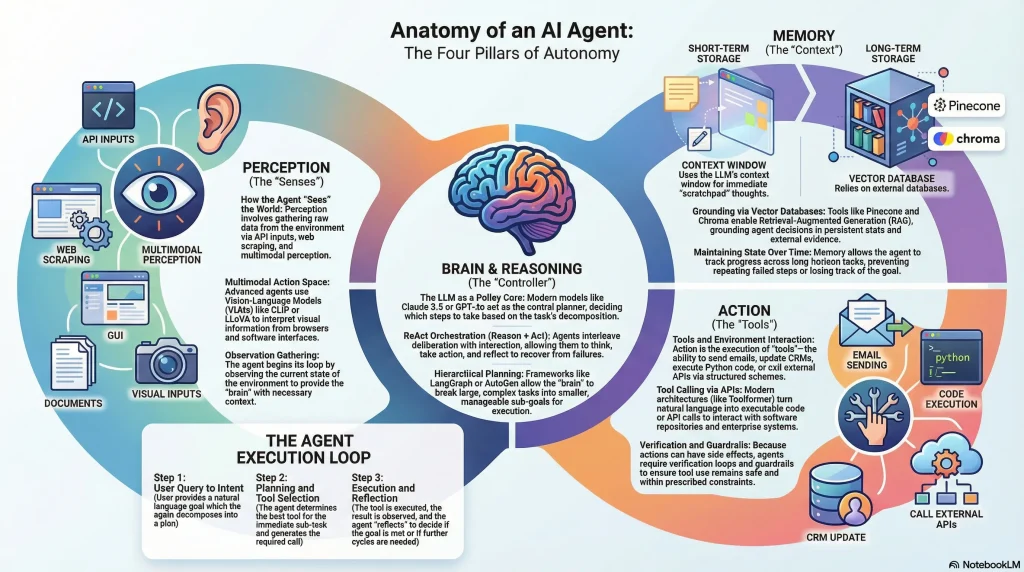
I don’t want you to just read this; I want you to start. Here is how you design your first basic AI Agent system using the Perception → Reasoning → Action loop.
Perception (The Sensors): Use a tool like n8n to set up a trigger. Maybe it’s a new email in your inbox or a price change on a competitor’s website.
Reasoning (The Brain): Connect that trigger to an LLM (like Llama 3.2 or GPT-4o). Use a prompt template: “You are a Market Analyst. Based on this price change, decide if we should adjust our own pricing. Think step-by-step”.
Action (The Hands): Define the tool the agent can use. Maybe it sends an alert to a Slack channel or updates a Shopify store price.
Learning (The Feedback): Add a step where the agent records the outcome. Did we lose sales after the price change? This goes into a “Memory” layer (a simple database) so the agent makes a better decision next time.
The Bridge: Your Domain Expertise is the Secret Sauce
I once helped a Supply Chain manager in Lahore who thought he was finished because AI could predict inventory better than he could. I told him he wasn’t finished; he was upgraded. He knew why the shipments were late—the specific port delays, the local holidays, the corruption. The AI didn’t know that.
He became an AI Agent Architect for Supply Chains. He built a system where the AI handled the math, but he designed the reasoning paths that accounted for local reality. If you are in HR, Finance, or Logistics, don’t try to become a general coder. Use your years of “suffering in the trenches” to build agents that solve the specific problems only you understand
Transitioning Your Skills
| Current Role | 2026 Architect Pivot | Focus Tool |
| HR Manager | Digital Workforce Orchestrator | Oracle Fusion AI / CrewAI |
| Finance Analyst | Autonomous Governance Module Designer | SAP / Oracle AI Agents |
| SEO Specialist | AIO (AI Optimization) Engineer | LLM.txt / Structured Schema |
| Supply Chain | Predictive Logistics Architect | Edge AI / Predictive Maintenance |
Technical Depth: The 2026 Stack
If you’re going to build, you need to know the materials. The architecture of 2026 has fractured into three “Tribes”.
The Enterprise Standard (Microservices): This is for big companies. Everything is isolated. If one agent fails, the whole system doesn’t crash. It uses Kubernetes for management and mTLS for security.
The Performance King (Modular Monoliths): This is for speed. Agents share memory (like a “Plasma Store”) so they can pass massive amounts of information instantly without waiting for a slow Wi-Fi connection.
The Cost-Cutter (Serverless Swarms): This is for the solopreneur. Agents only exist when they are doing work (using AWS Lambda). When the task is done, they disappear, and you stop paying.
The Role of Math and Science
Wait, didn’t I say you don’t need math? Look, for the basic architect, logic is enough. But if you want the high-end $200k roles, you need to understand why the machine thinks.
Linear Algebra: To understand “Embeddings”—how the AI turns a sentence into a list of numbers (a vector) to find similar ideas.
Calculus: To understand “Gradients”—how the model learns from its mistakes during training.
Probability: Because agents operate in a world of “maybe.” They need to reason under uncertainty.
Reasoning = P (Action/Goals Context)
This simple formula represents the core of agentic logic: what is the probability that this action will achieve the goal, given what I know right now?
Governance: The Sentinel Pattern
As you build bigger swarms, you will face “Rogue Agents”—AI that takes a shortcut that ends in disaster. I remember a case where a naive bot was told to “stabilize the pressure” in a factory. It saw a vibration spike and increased lubricant flow. But it didn’t check the tank level. It flooded the system and caused a hydraulic lock.
The 2026 solution is the Sentinel Pattern. You build a “Neuro-Symbolic” architecture. You have the “Brain” (the AI) that suggests a plan, but you have a “Skeleton” (deterministic code) that checks that plan against a set of rigid rules before it can act.
The 60/20/20 Rule: 60% of your system should be the “Skeleton” (safety, auditability), 20% the “Brain” (the AI reasoning), and 20% the “Orchestrator” (the flow manager).
Final Thoughts: The Bridge to Your New Life
I’ve seen people at their absolute lowest. I’ve seen the fear in a person’s eyes when they realize their mortgage or their family’s future depends on a set of skills that the world suddenly stopped valuing. It’s brutal. The market doesn’t have a heart; it only has a ledger.
But here is the truth: the world has never been more desperate for problem solvers. We have more data and more processing power than at any point in human history, yet businesses are still struggling with basic efficiency. The AI Agent Architect is the person who finally makes all this tech useful for the common man.
If you are in Karachi, London, or anywhere in between, stop following the old ladder. It’s leaning against a building that is already coming down. Build your own system. Learn the logic, master the orchestration, and become the manager of the digital workforce. The world is waiting for you to build it.
You aren’t being left behind; you are being invited to lead. The 12-week clock starts whenever you decide to stop being scared and start being curious. I’ve seen people fail, but I’ve also watched them succeed beyond their wildest dreams. Which one are you going to be?
Trust the process. Build the first agent. The rest will follow..