Career Next | The Rozgaar Ready Initiative: A Strategic Analysis of Human Capital Transformation in Pakistan’s Volatile Job Market
Imagine a ladder of iron, cold and unforgiving, stretching upward into the hazy skyline of Karachi or the morning fog of Lahore. This ladder represents the “Pakistan Dream,” the traditional promise that a four-year degree, coupled with relentless exertion and the sacrifice of one’s youth, would eventually lead to the stable plateau of the middle class. For decades, the professionals of this nation have climbed. They have gripped the rungs of primary education, secondary board exams, and rigorous university semesters until their fingers were calloused. They have navigated the thin, oxygen-deprived air of entry-level internships and junior associate roles, always looking upward, always believing that the next rung would bring them to safety.
But as the year 2025 approaches, a terrifying vibration is felt through the metal. It is not the sound of wind or progress. It is the sound of the ladder being dismantled from the top down. The psychological struggle of the modern Pakistani professional is defined by this crushing realization: the rungs they are reaching for are no longer there. The credentials that once felt like solid steel—the engineering degrees from top-tier universities, the MBAs, the specialized certifications—now feel as brittle as sun-bleached wood, rotting under the dual weight of a stagnating economy and the relentless, unblinking march of automation.
This is the “Replaceability Crisis.” It is a state where a professional realizes that their ten years of experience or their high-GPA degree does not make them an asset, but a variable in an equation where the solution is increasingly a line of code or a robotic arm in a Faisalabad textile mill. This crisis manifests as a profound sense of being “surplus” to requirements. When the effort of studying and applying no longer translates into the reward of stability, the resulting psychological cost is a toxic mixture of anxiety, self-doubt, and a systemic loss of trust. The professional is not just losing a job; they are losing the narrative of their own future.
Career Next Mapping the 2026 Employability Crisis in Pakistan
To understand the depth of this crisis, one must look beneath the surface of official statistics. While the national unemployment rate was recorded at 5.41% in 2023, the trajectory has moved steadily upward, reaching 5.47% in 2024, with forecasts suggesting a peak of 8% by 2025. However, these aggregate figures mask the true devastation occurring within the youth demographic. For those aged 15 to 35, the unemployment rate is not a minor statistical blip but a structural wall. Graduate unemployment, specifically, is nearly three times the average national rate, a paradox that suggests that the more one invests in traditional education, the more likely one is to face the professional abyss.
One of the most troubling metrics is the rise of the NEET population—young people who are Not in Education, Employment, or Training. Approximately 32.5% of Pakistan’s youth aged 15-29 fall into this category. The gender disparity within these figures is staggering, reflecting a massive reservoir of untapped human potential that remains locked behind cultural norms and a lack of flexible opportunities.
Comparative Labor Market Metrics (2023-2025)
| Metric | 2023 Value | 2024 Value | 2025 |
| National Unemployment Rate | 5.41% | 5.47% | 8.00% |
| Youth NEET Rate (National) | 30.2% | 32.5% | 35.0% |
| Graduate Unemployment Rate | ~14.0% | 16.1% | >18.0% |
| Female NEET Rate | 52.0% | 55.0% | 58.0% |
| Male NEET Rate | 10.0% | 11.0% | 12.5% |
The underlying causes of this crisis are rooted in a fundamental disconnect between the “knowledge” produced by academic institutions and the “utility” required by the modern economy. Pakistan currently ranks 99th out of 139 economies in the Global Innovation Index (GII) 2025, a reflection of poor overall innovation performance and a decline in innovation inputs, where it ranks even lower at 124th. This suggests that the country’s infrastructure for talent development is not just stagnant; it is actively falling behind the global curve.
The industry-academia gap is not a new phenomenon, but in 2025, it has reached a breaking point. Universities continue to operate as silos, disconnected from the actual hiring practices of modern firms. Students are encouraged to “just graduate,” yet they are never taught how to navigate a market that treats entry-level hiring as a cost to be minimized rather than an investment to be nurtured. The result is a generation that is “educated on paper but stranded in practice”.
The Algorithm of Displacement: How AI is Reshaping the Labor Landscape
The economic stagnation is compounded by a technological shift that is both invisible and omnipresent. Artificial Intelligence (AI) is no longer a futuristic concept discussed in the tech hubs of Silicon Valley; it is a live threat and a live opportunity within the Pakistani industrial complex. A study conducted in late 2024 warned that roughly 17% of the Pakistani workforce one in every six jobs is at “high risk” of being automated.
The Siege of the Industrial Backbone
In the textile sector, which serves as the largest employer of factory labor in the country, the transition is particularly stark. Multibillion-rupee mills in cities like Karachi and Faisalabad are quietly upgrading to AI-driven equipment. Automated looms now weave fabric at speeds and precision levels that no human could ever replicate. More significantly, computer-vision systems are being piloted to inspect cloth for defects, and “pick and stitch” robots are beginning to handle garments on the fly.
The implication is clear: the predictive maintenance and robotic systems that save money for profit-driven firms are simultaneously making millions of low-skilled garment workers obsolete. Economists note that because Pakistan relies heavily on routine manual and clerical work, it is uniquely vulnerable to the types of tasks that machines do best.
White-Collar Vulnerability and Service Sector Disruption
The threat is not confined to the factory floor. In the gleaming offices of banks and telecommunications firms in Islamabad and Karachi, white-collar and semi-skilled service jobs are facing similar perils. Customer service and back-office operations sectors that have traditionally provided a refuge for fresh graduates are being hollowed out.
Banks are increasingly deploying self-service apps and intelligent kiosk systems that automate routine account processing and inquiries. Tellers and data-entry clerks are the first to be displaced as these technologies reach maturity. In the Business Process Outsourcing (BPO) sector, AI tools are handling tasks once performed by humans with greater speed and lower overhead. Even the logistics sector, which supports an estimated 200,000 truckers and delivery workers, faces long-term ruin if driverless trucks or automated delivery drones are introduced as they have been in other global market
High-Risk Sectors for AI Displacement (2025-2030 Outlook)
| Sector | Estimated Workforce at Risk | Primary Displacement Driver |
| Textile & Garments | 60% | Robotic stitching & computer vision |
| Banking & Finance | 45% | Automated inquiries & kiosk systems |
| Logistics & Transport | 30% | Autonomous vehicles & automated warehouses |
| Customer Service/BPO | 50% | Conversational AI & NLP chatbots |
| Agriculture | 25% | Precision farming & automated harvesting |
The Rozgaar Ready Programme: A Human-Centric Pivot
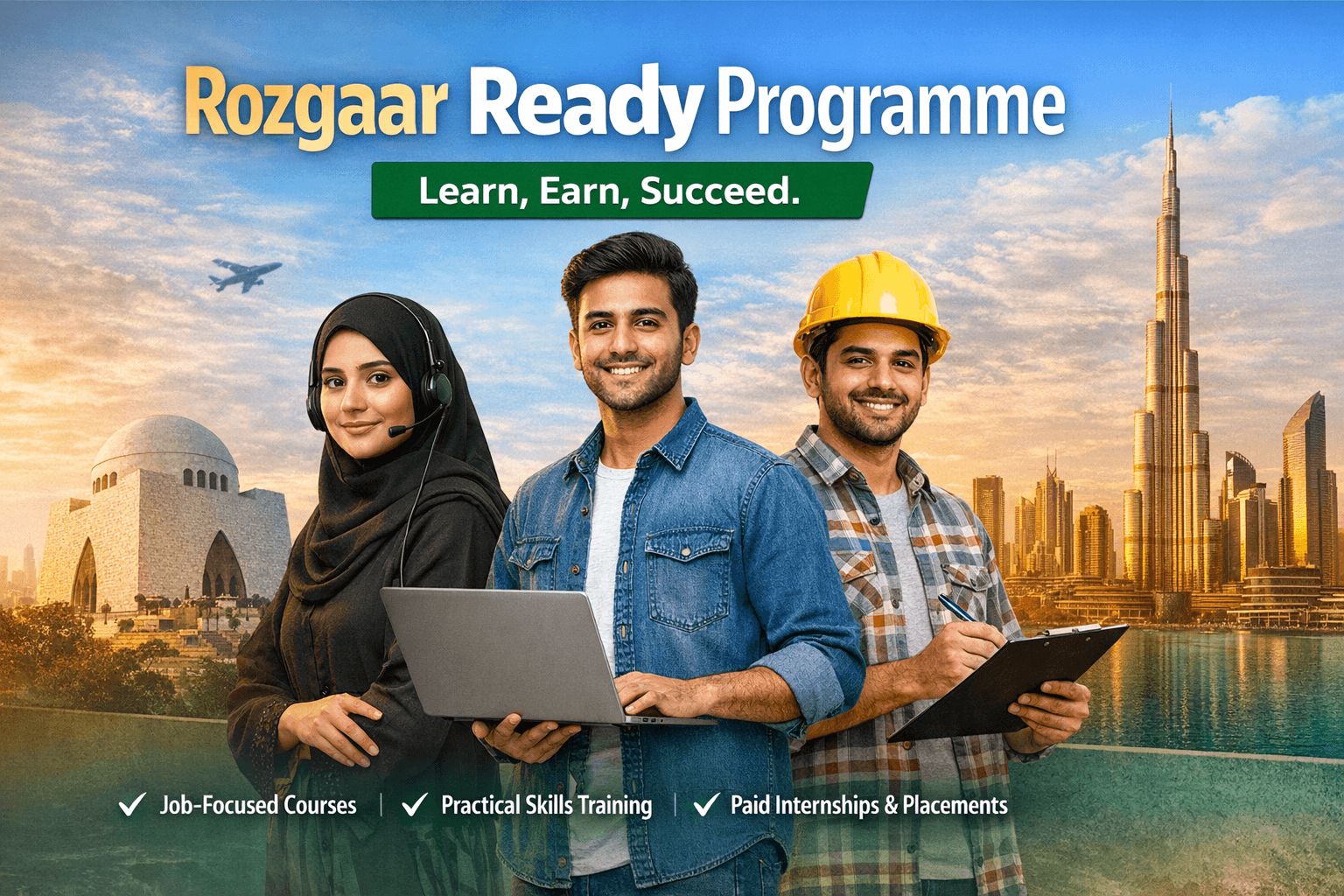
In the face of this systemic displacement, the Rozgaar Ready Programme (and its broader ecosystem including e-Rozgaar 2.0) has emerged not as a traditional training course, but as a tactical intervention designed to re-engineer the Pakistani professional for the era of automation. This program is built on the premise that if the ladder is breaking, the professional must learn how to build their own wings.
The core of the program’s philosophy is the “Employability and Job Readiness” framework, which shifts the focus from academic credentials to “Big Five” essential skills: communication, financial literacy, resilience, work ethic, and the capacity to function as part of a team. The program recognizes that while technical skills may have a half-life of only a few years, these core human competencies are the only true hedge against replacement.
The Mechanism of Transformation
The program’s methodology involves moving beyond passive instruction to active, problem-focused learning. It seeks to address the mental health challenges and risk factors that lead to high school and college dropouts, such as learning disabilities and economic instability. By cultivating self-confidence and social skills, the program has demonstrated an ability to help struggling youth graduate and gain the motivation to apply for and fulfill jobs.
The curriculum is structured into four primary elements:
Practical Workplace Mastery: This involves a rapid upgrade of literacy, numeracy, and digital proficiency, ensuring that every participant can navigate the basic tools of the modern office.
Communication and Ethical Navigation: This pillar focuses on resume writing, oral communication, and a code of professional ethics, teaching graduates the “hidden language” of the corporate world.
Job Hunting as a Science: Participants are taught the art of research, networking, and seeking mentorship, transforming them from passive job seekers into active career strategists.
Entrepreneurial Resilience: For those who choose to exit the traditional workforce, the program provides high school and vocational credits for experiential learning in the art of starting a business.
Curriculum Deep Dive: Mastering AI and Machine Learning
The most significant pathway offered by the Rozgaar Ready initiative is the transition into the high-tech sector. The National AI Policy of Pakistan aims to create over 100,000 tech jobs by 2025 and train 1 million AI professionals by 2030. This is not merely an ambitious goal; it is a necessity for national survival.
The AI and Machine Learning track is designed to turn the “displaced” into “disruptors.” The market for AI in Pakistan is projected to grow by 28.66% annually, reaching a valuation of US$3.2 billion by 2030. Graduates of this track are trained to move beyond simply using AI to building it.
Technical Proficiency and Salary Prospects
The curriculum focuses on the languages and frameworks that are in highest demand globally. Mastering Python is the first step, followed by hands-on experience with TensorFlow and Keras for building AI models. Participants learn the fundamentals of neural networks, Natural Language Processing (NLP), and computer vision the very technologies that are currently disrupting the textile and service sectors.
Technical Skills Growth and Salary Benchmarks (2026)
| Skill Track | Projected Job Growth | Average Salary (PKR/Year) | Essential Tools |
| AI/ML Engineering | 23.0% | 1,200,000 – 3,000,000 | Python, TensorFlow, LangChain |
| Data Science | 19.0% | 1,000,000 – 2,500,000 | SQL, Tableau, Power BI |
| Cybersecurity | 18.0% | 1,000,000 – 2,500,000 | Threat Detection, Risk Mgmt |
| Cloud Computing | 20.5% | 900,000 – 2,200,000 | Kubernetes, Docker, AWS |
This track addresses the “data literacy” gap that prevents most Pakistani firms from scaling. As nearly half of all Pakistani companies are expected to use advanced analytics by 2026, the demand for individuals who can convert raw data into actionable insights is skyrocketing.
The E-Commerce Explosion and Digital Marketing Mastery
While AI represents the high-tech frontier, Digital Marketing and E-commerce represent the current economic engine of the Pakistani middle class. E-commerce transactions grew by 35% in 2024, with total sales surpassing PKR 200 billion by mid-2025. By 2026, the market is expected to exceed PKR 500 billion, driven by the fact that over 70% of digital traffic in the country now comes from mobile devices.
The Rozgaar Ready track in this domain focuses on the shift toward “Social Commerce,” where buying and selling happen directly within platforms like Instagram, TikTok, and WhatsApp. The curriculum moves beyond basic social media management to cover:
Performance Marketing: Understanding Google Ads, Facebook Insights, and AI-powered chatbots to drive sales.
Creative Assets: Mastery of Figma for UI/UX design and Adobe Creative Suite for high-impact visual storytelling.
Content Strategy: SEO/SEM and influencer marketing, tailored to the specific consumer psychology of the Pakistani audience.
The goal is to equip students with high-income digital skills that allow them to participate in the global freelancing economy. In 2025, freelancing is no longer a “side gig” but a full-time career path that offers freedom from the volatility of the local job market.
Technical Resilience: The Solar Technician Revolution
Perhaps the most pragmatic and immediate pathway offered by the initiative is the Solar Technician certification. Pakistan is facing a chronic energy crisis, characterized by rising electricity tariffs and a fragile national grid. This has led to an explosion in the demand for decentralized solar power solutions for residential, commercial, and industrial use.
The Solar industry is flourishing, but it faces a dire shortage of technical experts. Many installations fail or underperform because they are handled by untrained labor. The Rozgaar Ready Solar Technician course is a 3-month intensive program designed to produce employable, skilled manpower that meets international standards.
Curriculum Breakdown for Solar Mastery
The curriculum is a blend of theoretical physics and hands-on field experience. Students move from understanding the principles of solar energy to performing live installations on actual sites.
System Design & Planning: Learning shade analysis, panel positioning, and how to calculate client loads based on energy bills.
Mechanical & Electrical Installation: Hands-on training in panel mounting, DC vs. AC wiring, cable sizing, and the use of MC4 connectors.
Inverter Commissioning: Understanding the differences between on-grid, hybrid, and off-grid inverters, and how to configure them for maximum efficiency.
Maintenance & Fault Rectification: Training in routine inspections, inverter error code diagnostics, and panel cleaning protocols.
Navigating the Future: From Degree-Seeker to Skill-Master
The transition from a “replaceable” professional to a “resilient” one requires a fundamental shift in the individual’s relationship with education. In the traditional model, education was a finite destination—a degree that once earned, served as a lifetime pass to employment. In the 2025 economy, education is a continuous process, a “future-ready” ecosystem that must be updated as frequently as a smartphone’s operating system.
Future-ready education prioritizes critical thinking, digital literacy, and lifelong learning tools. It replaces passive instruction with authentic assessment methods, such as digital portfolios and real-world projects. For the Pakistani professional, this means moving away from the obsession with “enrollment” and toward an obsession with “outcomes.”
The hiring pool of Gen Z workers expands by more than ten times when employers use a “skills-first” hiring approach. This shift is particularly beneficial for women, whose representation in hiring pools grows by 24% when the focus is on what they can do rather than where they graduated.
Comprehensive FAQ for the Career-Focused Graduate
The Transformation Narrative: From Survival to Mastery
The story of the Pakistani professional in 2025 does not have to be a tragedy of displacement. The ladder may be breaking, but the ground beneath it is shifting toward a new kind of opportunity. The “Replaceability Crisis” is, at its heart, a call to action. It is an invitation to shed the skin of the “paper graduate” and emerge as a “skill master.”
When a professional stops viewing themselves as a passive recipient of academic credentials and starts viewing themselves as a dynamic problem-solver equipped with the tools of AI, the precision of renewable energy technology, and the agility of digital marketing, the vibration of the ladder no longer feels like a threat. It feels like an engine starting up. The Rozgaar Ready initiative is the blueprint for that engine. By aligning individual effort with the actual needs of the 2025 economy, the professionals of Pakistan can stop climbing the broken rungs of the past and start building the future they were always promised.