Comparison Guide
CS Degree vs Engineering vs Business: Which is Actually Worth It?
Evaluating starting pay, job security, regional mobility, and AI disruption across computer science, engineering, and business pathways.

Evaluating starting pay, job security, regional mobility, and AI disruption across computer science, engineering, and business pathways.
When deciding on a CS degree vs engineering vs business, students in 2026 must evaluate job stability against growth potential to choose the path that yields the strongest career ROI.
Quick answer: In 2026, there is no single "best" degree. A computer science degree delivers the highest starting pay and strongest remote-work reach, Engineering offers the most durable demand in infrastructure and industrial sectors, and Business produces the widest range of outcomes — paying off best when paired with finance, analytics, or leadership skills. The right choice depends on aptitude, target country, and willingness to build skills beyond the degree itself.
Quick answer: No single degree is winning or losing in 2026 — US Bureau of Labor Statistics projections show computer/IT, engineering, and business occupations all growing faster than average through 2034, which means the deciding factor is increasingly which skills a graduate stacks on top of the degree, not the degree label itself.
Computer and information technology occupations are projected to grow much faster than the average occupation between 2024 and 2034, adding roughly 317,700 openings a year, with a 2024 median wage of $105,990. Engineering occupations show comparably strong momentum: industrial engineering is projected to grow 11.0% and mechanical engineering 9.1% over the same decade, with many roles paying above $100,000 median. Business and financial occupations are also expanding faster than average, adding close to 942,500 openings per year at a 2024 median wage of $80,920 — while management occupations specifically carry a median wage of $122,090.
None of these three fields is shrinking. What's changed is the hiring filter behind them. 2026 hiring-demand coverage places finance, mechanical engineering, computer science, accounting, business administration, and electrical engineering near the top of employer priority lists — a clear signal that the market rewards degrees mapping to measurable, quantifiable value, not prestige on a transcript. For the most current version of these figures, the primary source is the BLS Occupational Outlook Handbook, which is updated on a rolling basis.
Quick answer: Yes — CS remains one of the highest-paying, most globally portable degrees, but AI has raised the bar for entry-level graduates by automating routine coding and basic testing, meaning the CS graduates winning today combine programming with cloud, data, cybersecurity, and product thinking.
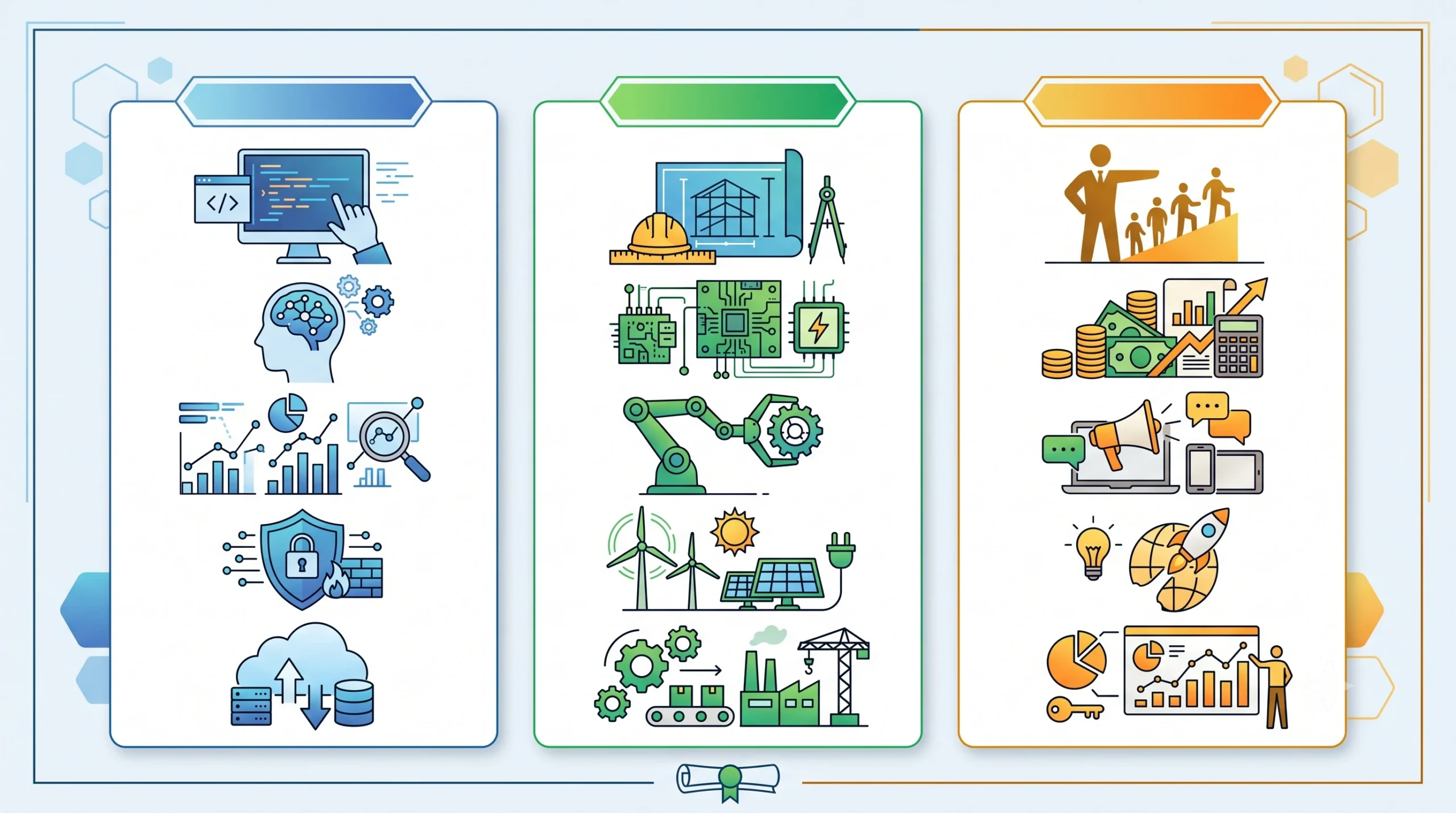
BLS data shows high median pay across software developers, information security analysts, database architects, and computer network architects, and the field overall continues to grow much faster than average. But the entry-level layer of the market has genuinely shifted: routine coding, simple QA testing, basic web development, and low-complexity support tasks are increasingly automatable. A generic CS graduate with no portfolio and no specialization is now weaker in the hiring pool than a graduate who can build full systems, work with real data pipelines, deploy cloud infrastructure, and ship a finished product end to end.
AI hasn't killed CS — it's raised the passing grade. The CS graduates thriving in 2026 treat programming as one tool among several — cloud platforms, AI tooling, cybersecurity fundamentals, data engineering — rather than the entire skillset. Consider referencing our customized remote work guidance for strategies to stand out.
Quick answer: Engineering is not dead — it's a specialized, infrastructure-anchored field with strong long-term stability, particularly in industrial, mechanical, electrical, and civil disciplines tied to energy, automation, and manufacturing modernization, though it can be slower-paced and more location-bound than CS.

BLS projections show above-average growth for several engineering occupations, and pay is strong across the board: many roles clear the $100,000 median mark, with computer hardware engineers reaching a $155,020 median in 2024 data — higher than the median for many CS-adjacent roles.
Where engineering shows its comparative weakness is portability and pacing. Civil and mechanical work is often tied to construction cycles, manufacturing output, and large infrastructure projects, which makes the job market feel slower and more regionally dependent in some countries. Software and embedded systems roles inside engineering, by contrast, are growing faster than the traditional physical-systems side of the field. The engineering graduates seeing the strongest outcomes in 2026 are layering BIM, simulation software, automation and PLC systems, CAD/CAM, data tools, and project management on top of their core technical training — the same lesson as CS: the degree is a floor, not a ceiling.
Quick answer: A business degree pays off in 2026 only when paired with a specialization — finance, analytics, supply chain, digital marketing, or entrepreneurship — because a generic, skills-free business degree is exactly the profile AI automates first.

BLS data shows strong demand in business and financial occupations, and especially strong pay in management roles — financial managers, marketing managers, project management specialists, and business analysts all rank as strong earners. But business carries the most misunderstood reputation of the three degrees, often dismissed as "easy" — a reputation earned specifically by graduates leaving with no quantitative skill, no software fluency, no sales ability, and no practical experience.
AI is already automating the routine layer of business work: reporting, basic market analysis, scheduling, simple content creation, admin tasks. What it's increasing demand for is the judgment layer — interpreting data, leading teams, managing client relationships, negotiating, deciding under real uncertainty. Business has the widest outcome range of the three degrees, capable of producing both the weakest and some of the highest-paid graduates, depending entirely on what the student builds around the core degree.
| Category | Computer Science | Engineering | Business |
|---|---|---|---|
| Job opportunities | Very strong — software, data, AI, cybersecurity, cloud | Strong — industrial, mechanical, electrical, civil, energy | Strong — finance, analytics, ops, marketing, management |
| Salary potential | High, often above national averages | High, many roles exceed $100K median | Moderate to high; top roles pay very well |
| Remote work | Very high | Low to moderate (except software/automation engineers) | High for analysis, marketing, finance, consulting |
| International mobility | Very high | High, especially GCC and industrial markets | High, especially finance and multinational firms |
| Entrepreneurship | Very high (apps, SaaS, AI products) | Moderate (hardware, manufacturing, consulting) | Very high, especially with sales/digital skills |
| AI disruption risk | Medium-high for routine coding; low for systems/security | Medium — physical systems still need humans | Medium-high for routine tasks; low for leadership roles |
| Skills to add | Cloud, AI tools, databases, system design | CAD/BIM, simulation, PLCs, project management | Excel, SQL, analytics, negotiation, AI tools |
| Difficulty | High | High | Moderate |
Quick answer: CS currently leads on starting salary in the US — one 2026 NACE-related report cites a starting salary near $81,535, against a broader BLS median for IT occupations above $105,000. Engineering trails closely with many roles above $100,000 median, while Business is the most spread out, with finance and management paying very well but the overall field median lower than CS and Engineering.
For students in Pakistan and the UAE, exact outcomes depend heavily on specialization and internship experience rather than the degree title alone — but the pattern holds regionally too: CS usually has the fastest path to remote income, Engineering often delivers strong salaried growth inside GCC project markets, and Business offers the widest possible range of outcomes, from underwhelming to excellent, depending on role quality and added skills.
The real ROI lesson: the best degree is the one that gets a student employable early and lets them compound skills over time — not the one that sounds most impressive on paper. Building a solid application portfolio will be much more important than a degree transcript. Consider optimizing your profile with our dedicated resume writing services to show your practical skills.
Quick answer: For Pakistani students, CS has the clearest path to overseas and freelance income because software, data, and cybersecurity work can be sold globally with the right portfolio and English communication skills, while Engineering suits GCC infrastructure markets and Business travels well only when paired with finance, analytics, or sales specialization.
A blunt, practical truth applies across all three degrees locally: many graduates hold the credential but lack the software tools, writing ability, Excel proficiency, data skills, portfolio work, or internship experience that actually gets hired. The student who can prove skill with real work samples consistently beats the student with the "better" degree title on paper. Consider exploring our Rozgaar Ready Programme to fast-track your practical career preparedness.
Use the following target outcomes to match your profile and pick the ideal degree path:
Go with Engineering, if you like physical systems, design, and hands-on execution.
Go with Computer Science, especially for AI, cloud, cybersecurity, or product roles.
Go with Business, but pair it with analytics, finance, or sales from day one.
Choosing between CS, Engineering, and Business in 2026 isn't about picking a winner — it's about matching aptitude to a field, then treating the degree as a floor rather than a finish line. CS rewards technical builders willing to keep learning past graduation. Engineering rewards systems thinkers who want durable, infrastructure-anchored careers. Business rewards operators and leaders who pair the degree with hard, quantifiable skills. The graduates who win in any of the three paths share one thing: they built proof of skill that AI can't easily replicate.
Explore our comprehensive career counseling services in Pakistan to find your pathway.
Learn More About Career Guidance →Founder & Lead Career Counselor at CareerNext.pk. Helping Pakistani professionals secure high-paying local and remote jobs.
Strategic advice on landing placement in the current economy.
Read Excerpt →Get professional career guidance, resume reviews, and placement opportunities directly at our Karachi office.
📍 Garden City, Scheme-45, Karachi, Pakistan
View Google Business Profile