
Anxiety in Students: "History's Lessons: A Call to Revive Education"
Introduction
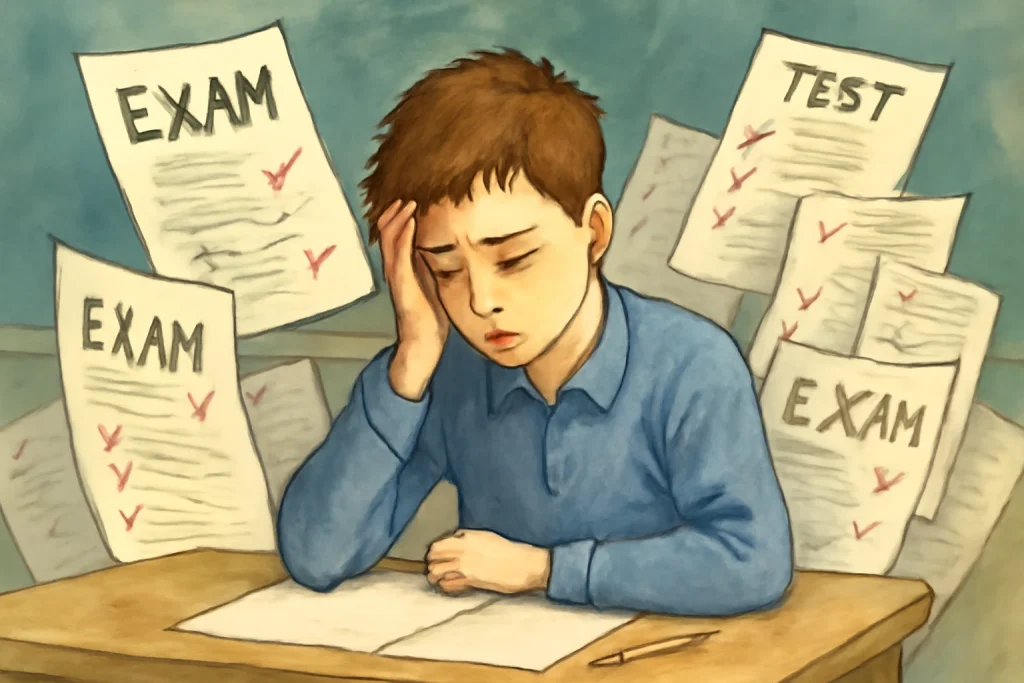
Anxiety in students is one of the most pressing challenges of our age. Across the globe and especially in Eastern Asia and Pakistan children grow up in classrooms filled with pressure: What if I fail? What if the teacher scolds me? What will my parents say? Instead of seeing school as a place of curiosity and creativity, many students associate it with fear, stress, and mental strain. Yet if we look back in history, children were often bold, sharp, and even genius without formal education systems. Ancient societies nurtured minds in ways that seem foreign today – more practical, more personalized, and often more empowering.
This blog explores:
- How children learned in the past without structured schooling.
- Why young generals and leaders thrived in their teens and twenties.
- How our “one-size-fits-all” education stifles uniqueness.
- Why today’s system creates anxiety in students instead of confidence.
- The role of parents, teachers, and culture – including a focus on Pakistan.
- How to reduce stress and revive a child-centered, fear-free learning environment.
Data and Findings
Student anxiety is a widespread concern, with research indicating that roughly one-third of university students globally experience elevated anxiety levels. reference
In Pakistan, recent surveys report an even higher incidence – about 40% of university students suffer from significant anxiety symptoms. researchgate.
This high prevalence is alarming because anxiety can erode students’ overall well-being and hinder their success. Studies have shown that when student well-being declines, it often leads to mental health problems (including anxiety and depression) and can impair academic achievement or even prompt students to drop out. Reference
Below, we summarize key quantitative and qualitative findings that shed light on how anxiety affects students’ wellness, performance, and relationships, and what can be done about it.
Student Anxiety in Pakistan: A Socio-Ecological Perspective
A 2025 study on Pakistani university students (N = 280) underscores that student well-being is shaped by multiple layers of influence. reference
Individual emotional skills, such as effective emotion regulation, emerged as important predictors of better psychological health.
At the same time, strong family bonds and friendships (interpersonal support), a supportive community and campus environment, and even cultural factors like religious practices were all associated with higher student well-being reference
These findings support a socio-ecological view of mental health, where factors ranging from personal coping skills to community resources collectively determine a student’s psychological well-being.
The study’s results are sobering: a sizeable portion of students were found to have low well-being or high distress, reflecting the mental health challenges on campuses.
On a positive note, the researchers highlight that stakeholders can play a proactive role in improving student outcomes. Parents, university authorities, and community leaders in Pakistan can collaborate to bolster protective factors – for example, by fostering strong support networks, offering counseling services, and providing better campus facilities thereby enhancing students’ well-being and resilience. reference
This comprehensive approach is critical in a context where anxiety and related distress are so prevalent.
Insights from Global Research on Anxiety in Students
Chronicity and Severity of Anxiety in Students Disorders: Long-term research shows that serious anxiety disorders can follow a chronic course and significantly impair students’ lives.
The Harvard/Brown Anxiety Research Project (HARP), a longitudinal study of adults with social anxiety disorder, found that this condition often persists for years and has profound effects.
In fact, only about 35% of individuals with social anxiety disorder recovered after 10 years of follow-up, and even among those who improved, roughly one-third relapsed within the same period psychiatrist.com.
Notably, social anxiety had a greater adverse impact on day-to-day social functioning than even depression or many chronic medical illnesses psychiatrist.com.
These data highlight how debilitating untreated anxiety can be limiting students’ social lives, class participation, and networking opportunities – and underscore the need for early intervention.
Treatment for such disorders is often underutilized, suggesting that many students do not receive help until problems become severe
Academic Pressures and Performance: Research across different countries points to academics as a major source of student anxiety.
For example, a survey of 770 Malaysian university students identified five key triggers of study-related anxiety in students: exam pressure, fear of class presentations, mathematics related anxiety, language barriers, and social anxiety in campus life researchgate.net.
Among these, exam anxiety in students was reported as the leading stressor for students, closely followed by the stress of public speaking in class.
Such anxiety in students isn’t just an emotional hurdle – it has concrete academic consequences.
Highly anxious students tend to perform worse academically; studies have consistently found that students with elevated anxiety achieve lower grades and GPAs, likely due to impaired concentration and memory researchgate.net. One analysis noted that high anxiety correlates with poorer academic performance, as it saps the focus and confidence needed for learning and exams researchgate.net. On the bright side, acknowledging these specific anxiety sources allows educators to target them.
For instance, providing skills training for test-taking, presentation practice, or academic language support can directly address the areas students find most intimidating.
Impact on Social Relationships: Anxiety’s impact extends beyond academics into students’ social and family life.
Social anxiety in particular can make it difficult for students to form friendships, speak up in groups, or engage in campus activities effectively isolating them during a formative period of life.
As noted above, chronic social anxiety can erode social connections more severely than some depressive or physical health conditions do psychiatrist.com.
However, familial relationships might respond to anxiety in nuanced ways.
A qualitative case study in the United States explored families where one sibling has an anxiety disorder, providing a window into anxiety’s effect on sibling dynamics. Interestingly, the study found that anxiety in students did not necessarily damage the sibling bond or overall relationship quality digitalcommons.pcom.edu. Instead, many non-anxious siblings adopted a supportive, compensatory role: they would alter their own behavior and routines to help their anxious brother or sister cope and to prevent distressing situations digitalcommons.pcom.edu. These adjustments described by researchers as altruistic show how families often rally to buffer the impact of anxiety.
While this is heartening, it also underscores that anxiety can place additional responsibilities on siblings and family members.
In broader social terms, anxious students may rely on a few close peers or family members for support, potentially missing out on wider social experiences. This evidence highlights the importance of social support systems (friends, siblings, mentors) in mitigating the negative interpersonal effects of anxiety.
It also suggests that interventions should not only focus on the anxious individual, but consider involving families in education and support, so that helping a loved one with anxiety does not become an overwhelming burden.
Effective Coping Strategies and Interventions: Fortunately, research offers hope that targeted interventions can reduce student anxiety and improve outcomes.
One promising area is classroom-based anxiety reduction programs. In a case study of sixth-grade students, educators implemented a ten-session curriculum teaching simple, research backed coping techniques including progressive muscle relaxation, controlled breathing exercises, and positive self talk training scholarworks.wmich.eduscholarworks.wmich.edu.
The results were encouraging: students who received this instruction reported significant improvements in managing anxiety in students during stressful situations at school. Many participants showed a positive change in their ability to control anxious feelings when faced with typical anxiety triggers (like a difficult test or speaking in class) by actively using the taught strategies scholarworks.wmich.edu.
The strongest feedback theme from students was “I like it”, reflecting a sense of autonomy and confidence gained through practicing these techniques scholarworks.wmich.edu.
This suggests that even relatively brief mental-health education in the classroom can empower students with practical tools for anxiety relief.
Beyond individual skills, experts emphasize systemic measures to tackle anxiety in educational settings. University mental health professionals advocate for making counseling and psychological services more accessible on campus, as well as routine screening to identify struggling students early researchgate.net.
In Pakistan and elsewhere, researchers recommend that administrators and policymakers invest in student mental health by integrating support services and training into the education system researchgate.net.
The socio-ecological study in Pakistan similarly concludes that involvement from all levels – family, institutional, and community – is key to reducing student anxiety and promoting well being journals.publishing.umich.edu.
This could mean organizing parent awareness programs, training teachers to recognize and reduce classroom stressors, and providing community spaces for students to seek help without stigma. Overall, the findings across these studies converge on a clear message: student anxiety is a multifaceted challenge with serious implications for well-being, academic success, and relationships, but with a concerted effort and evidence-based strategies, stakeholders can significantly alleviate its impact on young people’s lives.
Ancient Learning: Education Without Classrooms
Before the 19th century, formal schooling as we know it barely existed. In traditional societies, children learned directly from family, mentors, and community life. A farmer’s child learned farming by joining in the field. A craftsman’s child learned trade skills by observation and apprenticeship. In ancient India, the gurukul system focused on holistic development – mind, body, and spirit – rather than just memorizing lessons. In Confucian China, education emphasized values, philosophy, and harmony, not test scores.
Children grew up fearless and bold because learning was natural, experiential, and not tied to punishment or humiliation. There were no standardized exams, so mistakes were seen as part of the journey.
Early Achievers: Courage Without Schools
History gives us countless examples of young people leading nations or armies long before modern education systems emerged:
- Alexander the Great conquered much of the known world by age 30, mentored by Aristotle but not tied to rote schooling.
- Muhammad bin Qasim, only 17, led the conquest of Sindh in 711 AD a moment deeply tied to Pakistan’s history. His leadership shows how a teenager could thrive with the right environment and trust.
- Napoleon Bonaparte rose to generalship at 24, learning strategy in real battles.
- Akbar the Great, crowned at 13, grew into one of the wisest rulers of South Asia.
Their education was about real-world mentorship and trust in youthful potential, not endless exams.
Young Scientific Minds: Observation Over Schooling
One of the strongest proofs that brilliance does not depend solely on formal education is found in the lives of great scientists and inventors. History is full of examples where individuals made extraordinary discoveries in their youth driven not by exams or classrooms, but by curiosity, observation, and experimentation. These stories remind us that anxiety in students is not only harmful but also unnecessary. With freedom to explore, children can often outpace the limits of structured schooling.
Thomas Edison – The Self-Taught Genius
Thomas Edison, one of the greatest inventors in history, had almost no formal education.
As a child, he attended school for only a few months. His teachers thought him “slow” because he asked too many questions and struggled with rote memorization.
Instead of thriving in classrooms, Edison learned through observation and tinkering. His mother pulled him out of school and taught him at home, allowing him to follow his interests. By age 12, he was already experimenting with chemicals and machinery.
Through self directed research, Edison went on to invent the phonograph, the electric light bulb, and over 1,000 patents. His story shows that strict schooling might have crushed his curiosity, but freedom allowed him to flourish.
Michael Faraday – From Bookbinder’s Apprentice to Electromagnetic Pioneer
Michael Faraday, the pioneer of electromagnetism, came from a poor family and received only the most basic schooling. At 13, he was apprenticed to a bookbinder, where he taught himself by reading the scientific books he was binding.
Fascinated by electricity and chemistry, he began experimenting in his free time.
By his twenties, Faraday made groundbreaking discoveries, including the principles of electromagnetic induction, which later enabled the creation of electric motors and transformers.
His rise from an uneducated apprentice to one of the world’s greatest scientists proves that learning by observation and curiosity can outshine traditional education.
Srinivasa Ramanujan – The Indian Mathematical Prodigy
In the early 20th century, Srinivasa Ramanujan from India became one of the most brilliant mathematicians the world has ever seen.
He had almost no formal training in advanced mathematics. In fact, he dropped out of college because he failed in non-math subjects.
But his obsessive self-study and original thinking led him to rediscover complex mathematical theorems on his own.
By his early 20s, Ramanujan was producing notebooks filled with thousands of unique results in number theory, infinite series, and continued fractions. When his work reached Cambridge, mathematician G. H. Hardy recognized his genius and invited him to England.
Ramanujan’s contributions continue to shape mathematics today. His life illustrates how a young, curious mind without structured schooling can reach extraordinary intellectual heights.
Albert Einstein – The Rebel Thinker
Albert Einstein, often regarded as the symbol of genius, did not excel in traditional schooling. As a child in Germany, he disliked rigid rote learning and often clashed with teachers.
He famously said, “Education is what remains after one has forgotten what one has learned in school.”
Einstein dropped out of school at 15, unable to tolerate its strictness. Yet his independent curiosity about physics and mathematics drove him to self-study.
By his mid-20s, while working in a Swiss patent office, Einstein had published four revolutionary papers in 1905 his “Annus Mirabilis” introducing special relativity and reshaping modern physics.
His example proves that imagination and curiosity, not exams, are the true engines of genius.
Blaise Pascal . Inventor in His Teens
Blaise Pascal, the French mathematician and physicist, showed brilliance from a very young age.
With minimal formal schooling, he taught himself geometry as a teenager and independently discovered several of Euclid’s theorems.
At just 19, he invented the Pascaline, one of the first mechanical calculators in history, to help his father with tax calculations.
Pascal’s youth-driven innovation demonstrates that when young people are given tools and encouragement, they can create solutions far ahead of their time.
Louis Braille – Changing the World at 15
Louis Braille, blinded in childhood, invented the Braille system of reading and writing when he was only 15 years old.
Frustrated with the limited systems for the blind, Braille developed his tactile code of raised dots after experimenting with simplified military codes.
His invention transformed literacy for the visually impaired across the world.
This achievement shows the power of youthful perspective: sometimes the young see solutions adults overlook.
Great Muslim Scientists:
Al-Khwarizmi (c. 780–850 CE)
- Era: Abbasid Caliphate, Baghdad
- Contribution: Known as the “Father of Algebra”; introduced algorithms and systematic methods that shaped mathematics; his works introduced Hindu-Arabic numerals to Europe.
- Education: Grew up in an intellectually vibrant environment in Baghdad’s House of Wisdom, where his early exposure to translations of Greek and Indian texts fueled his observational learning.
Ibn Sina (Avicenna) (980–1037 CE)
- Era: Islamic Golden Age, Persia
- Contribution: Wrote The Canon of Medicine, a foundational medical encyclopedia used for centuries in Europe and Asia; contributed to philosophy, astronomy, and psychology.
- Education: A child prodigy who mastered the Qur’an by age 10; studied medicine through observation of local healers and books in his father’s library before becoming a court physician at just 18.
Al-Razi (Rhazes) (865–925 CE)
- Era: Persia, Abbasid era
- Contribution: Pioneer in medicine; wrote Kitab al-Hawi (Comprehensive Book on Medicine); identified smallpox and measles; emphasized clinical observation.
- Education: Trained first as an alchemist and musician, then turned to medicine by observing patients and experimenting; much of his learning was self-driven.
Al-Biruni (973–1050 CE)
- Era: Khwarezm (Central Asia)
- Contribution: Contributions in astronomy, physics, geography, and mathematics; calculated Earth’s radius with remarkable accuracy; studied comparative religion and cultures.
- Education: Learned from local scholars and through self-observation; his curiosity about nature and the cosmos led to lifelong exploration.
Ibn al-Haytham (Alhazen) (965–1040 CE)
- Era: Basra and Cairo
- Contribution: Founder of modern optics; wrote Book of Optics explaining vision, reflection, and refraction through experimentation; introduced the scientific method.
- Education: Early love for observation of light and vision led him to practical experiments; most of his breakthroughs came from hands-on testing, not formal schools.
Ibn Khaldun (1332–1406 CE)
- Era: North Africa, Mamluk Sultanate
- Contribution: Father of sociology and historiography; wrote Muqaddimah, analyzing history, economics, and society scientifically.
- Education: Educated in classical Islamic sciences, but his greatest insights came from observing social and political events of his time rather than classroom theory.
Ibn al-Nafis (1213–1288 CE)
- Era: Damascus & Cairo, Ayyubid/Mamluk period
- Contribution: Discovered pulmonary circulation of blood centuries before William Harvey; wrote medical texts challenging Galen’s theories.
- Education: Trained in Damascus Bimaristan (hospital) where his direct observation of patients and dissections guided his discoveries.
Al-Tusi (1201–1274 CE)
- Era: Persia, Mongol period
- Contribution: Developed trigonometry as a separate branch of mathematics; made advances in astronomy and ethics.
- Education: Studied under scholars in Nishapur, but much of his mathematical insight came from independent research and observation.
From Al-Khwarizmi’s algorithms to Ibn Sina’s medical encyclopedias and Alhazen’s optics, these scholars prove that childhood curiosity and observation not exam anxiety are the roots of genius.
Many had little or no formal “schooling” in the modern sense; instead, they learned through libraries, mentors, and practical experiments.
Today, however, we keep our youth locked in rigid systems of rote learning, where fear of failure overshadows curiosity. Instead of nurturing observation and innovation, we burden them with anxiety.
If we wish to see new Ibn Sinas or Al-Birunis emerge, we must revive an education system that values exploration, creativity, and mental health above blind memorization.
A Crisis of Student Anxiety in Pakistan
In Pakistan today, education is often exam-driven and fear-based. From a young age, students face heavy homework, memorization, and constant comparisons. The dreaded board exams and university entrance tests dominate their teenage years, with failure treated as a personal and family disgrace.
This pressure translates into severe students’ anxiety:
- Children fear being insulted or punished by teachers in front of peers.
- Parents, often comparing siblings or neighbors’ kids, unintentionally burden children with unrealistic expectations.
- Teachers, pressured by results, sometimes discipline harshly instead of nurturing creativity.
Mental health awareness is still limited in Pakistan. Yet, cases of student suicides linked to exam pressure are reported each year, echoing similar crises in India, China, and South Korea. Instead of producing confident, risk-taking youth like Muhammad bin Qasim, our system often produces fearful, anxious young people afraid to make mistakes.
The One-Size-Fits-All Trap
God has created every individual unique. Yet modern schools treat children as if they were identical products on an assembly line. One syllabus, one exam, one measure of intelligence. This system is cruel because it ignores that some children are artists, others inventors, some thinkers, and some doers.
In Pakistan, the obsession with “doctor or engineer” careers is a painful example of this trap. Students with talents in arts, sports, entrepreneurship, or vocational trades are discouraged or belittled. This mismatch is a direct cause of anxiety in students, because they are forced to walk a path that does not fit them.
as per whitbyschool.org
Sir Ken Robinson, a renowned education reform advocate, put it aptly: “All kids have tremendous talents. And we squander them, pretty ruthlessly.”
Our schooling, he argues, often stifles the genius in each child by making them conform.
High grades end up measuring who is good at
Anxiety in Students: Fear as a Teaching Tool
The biggest culprit in anxiety in students today is fear. Fear of failure. Fear of punishment. Fear of humiliation.
In many Pakistani classrooms:
- Students dread being called to the board, lest they make a mistake and get scolded.
- Teachers sometimes use punishment as discipline, which destroys confidence.
- Parents demand top grades, comparing their child to others.
This culture creates a life of “what ifs” in children’s minds: What if I fail? What if I disappoint? What if I’m not good enough? Such thinking eats away at creativity and mental health. Instead of daring to innovate, children play safe. Instead of enjoying learning, they fear it.
What Did Ancient Teachers Teach?
Ancient mentors were guides, not taskmasters. They taught values, reasoning, physical skills, philosophy, and creativity. In the gurukul, children learned discipline through meditation, service, and exploration. In China, Confucian education was about virtue and wisdom. In the Islamic tradition, scholars encouraged critical thinking (ijtihad) and problem-solving.
The difference? Learning was about growth, not grades.
How to Save Students from Anxiety
To save students from anxiety, we need a new vision:
- Review the Curriculum: Make it student-friendly, with practical projects and local relevance.
- Reduce Exams & Homework Stress: Replace fear with curiosity. Use assessments as feedback, not punishment.
- Create Safe Classrooms: No insults, no harsh punishments. A school should be a second home.
- Encourage Learning by Doing: Let students observe, experiment, and create.
- Avoid Comparisons: Every child is unique; measure them against their own growth, not others.
- Parental Support: Parents should guide with love, not pressure. Recognize effort, not just grades.
- Mental Health Awareness: Schools must teach coping skills, provide counseling, and destigmatize mental health conversations.
If implemented, these changes would not only reduce anxiety in students, but also revive creativity, boldness, and the joy of learning.
FAQ: Anxiety in Students
Q1. How does anxiety affect kids in school?
Anxiety in students leads to poor concentration, lack of confidence, and declining grades. Children may avoid class participation out of fear of embarrassment, and long term anxiety can even cause depression or physical health problems.
Q2. What can cause anxiety in students?
The main causes include:
- Fear of failure and exams.
- Fear of punishment or public humiliation by teachers.
- Constant comparisons by parents or peers.
- Overloaded homework and rigid curricula.
- Lack of mental health support.
Q3. How to reduce anxiety and stress in students?
- Review the curriculum to make it practical and engaging.
- Reduce exam stress by focusing on learning, not ranking.
- Train teachers to be guides, not enforcers.
- Encourage creativity, play, and observation-based learning.
- Make classrooms safe spaces where mistakes are accepted as part of growth.
Q4. What role do parents and teachers play?
Parents and teachers are key. Parents should avoid comparisons and focus on their child’s individual strengths. Teachers must avoid insults and punishment, instead inspiring through encouragement. Together, they can create a learning environment where children want to go to school willingly.
Q5. Why is mental health awareness important in schools?
Because without mental health awareness, students’ struggles are ignored or misunderstood. Anxiety in students can silently destroy confidence, creativity, and even lives. Awareness ensures early support, healthier coping strategies, and stronger resilience.
Note: Being 17+ years in Education Sector, above are my observation, my thaughts has brought into written form by AI.