
If you've ever felt a pull toward a career and then talked yourself out of it before writing the first line of a resume, you're not alone, and you're not broken. You're running on a very old piece of psychological software. This guide — grounded in decades of vocational psychology research and built for how Career Next approaches career counseling — unpacks exactly how that software works, and how to override it.
💡 Key Takeaways
- Career choice is not a single event; it's a lifelong process that shifts with age and identity (Super).
- You unconsciously eliminate options that feel "not for people like me" long before you consciously evaluate them (Gottfredson).
- Confidence, not raw ability, is usually the deciding factor in whether you pursue a path (Bandura/SCCT).
- Career self-sabotage — impostor syndrome, analysis paralysis, fear of failure — is a pattern, not a personality flaw, and patterns can be interrupted.
- A practical, evidence-based framework exists to identify and dismantle these filters. It's outlined at the end of this article.
The Lie We're Told About Career Choice
We spend roughly a third of our waking adult lives at work. Because the stakes feel so high, we're taught to treat career choice as a single, high-pressure event — pick correctly once, and you're set for life. Change your mind at 30 or 45, and it's framed as failure, drift, or a "quarter-life crisis."
But vocational psychology has rejected that model for over fifty years. Career development isn't a single decision. It's an evolving, lifelong process — and understanding why it evolves is the first step to understanding why you may have already rejected options that were genuinely right for you.
Myth vs. Fact
| Myth | Fact |
|---|---|
| Choosing the "wrong" career early is a permanent mistake. | Career priorities are supposed to shift as your self-concept and life roles change (Super's Life-Span Theory). |
| If you were truly capable, you'd naturally gravitate toward the best-fit career. | Capable people routinely avoid high-fit careers because of social filtering, not ability (Gottfredson). |
| Confidence is a personality trait — you either have it or you don't. | Confidence (self-efficacy) is built through specific, learnable experiences (Bandura's SCCT). |
| Changing direction mid-career signals instability. | Changing direction in your late 30s–40s is a normal developmental stage, not a red flag. Learn more in our guide to sustainable careers. |
Chapter 1: The Lifespan Blueprint — Donald Super's Life-Span, Life-Space Theory
What It Is
Donald Super's Life-Span, Life-Space Theory holds that career development is a continuous process driven by an evolving self-concept — your internal sense of who you are, what you value, and what kind of work fits that identity. Rather than locking into one path, people move through five broad career stages as they age.
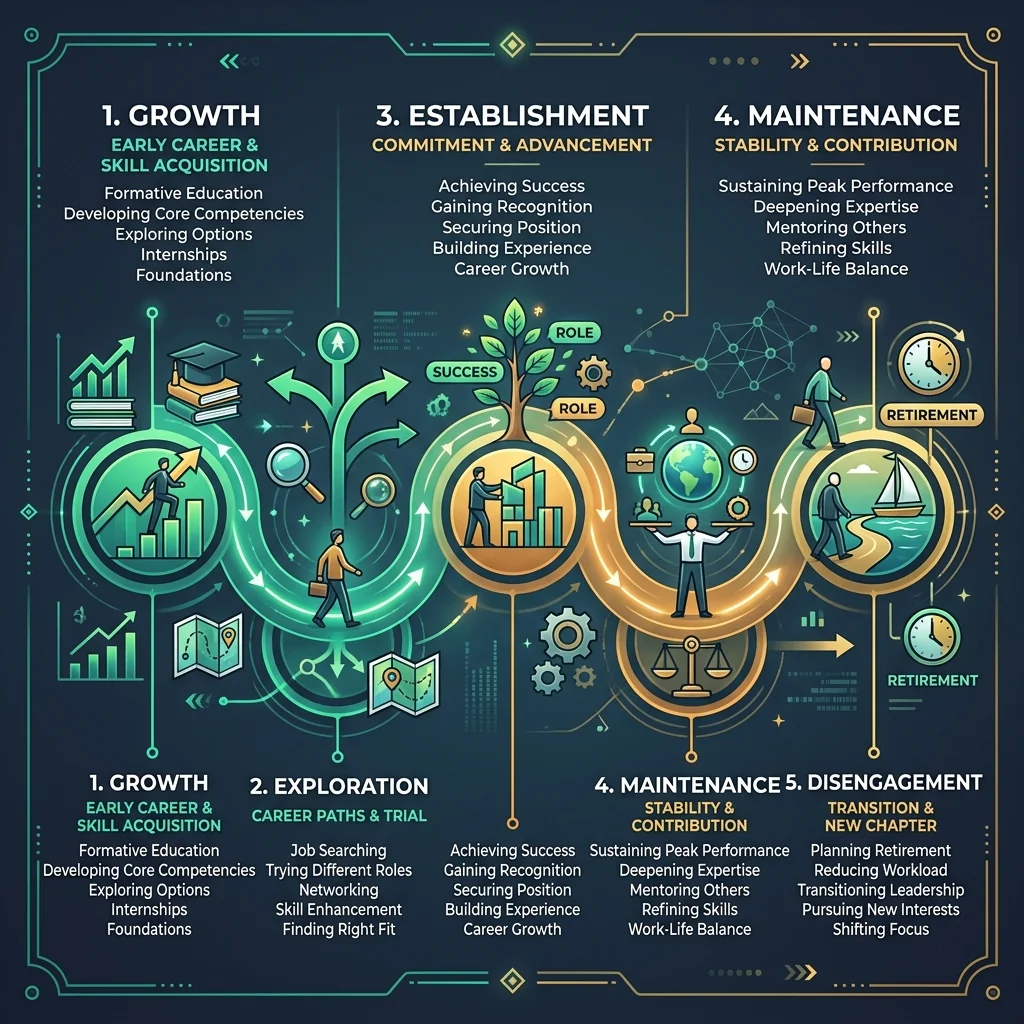
The five stages:
Why It Matters
At the same time you're moving through these stages, you're also juggling multiple life roles — worker, parent, spouse, student, citizen, caregiver. When these roles collide, your career priorities should change. A 24-year-old prioritizing salary and prestige is developmentally normal. A 40-year-old suddenly prioritizing flexibility, stability, or meaning over status isn't "losing ambition" — it's the Maintenance stage doing exactly what it's supposed to do.
📌 Real-World Example
Consider someone who spent their twenties in high-intensity investment banking, chasing title and income during the Establishment stage. By their late thirties, with a young family, they pivot to a role with better work-life balance. Under outdated models, this reads as "giving up." Under Super's framework, it's a textbook, healthy transition from Establishment into Maintenance — their self-concept evolved, and their career choice evolved with it.
Limitations and Modern Interpretation
Super's original stage model was developed decades ago in a labor market with more linear career ladders. Modern careers are less linear — people re-enter Exploration multiple times (career changes, layoffs, upskilling), sometimes called "recycling" through the stages. Researchers now treat the five stages less like a fixed ladder and more like a spiral you revisit throughout life.
🎯 Career Next Takeaway
If you're rethinking your career path right now, that's not a sign something went wrong. It may simply mean your self-concept has grown, and your career hasn't caught up yet. Career Next's career counseling approach is built around this exact idea — your plan should evolve with you, not the other way around.
Chapter 2: The Invisible Filter — Linda Gottfredson's Circumscription and Compromise
What It Is
Linda Gottfredson's theory explains a harder truth: most people never actually evaluate the full job market. Long before any formal decision is made, options are eliminated through an unconscious process called circumscription — narrowing the field based on perceived fit with sex-type, prestige level, and social identity, not ability.
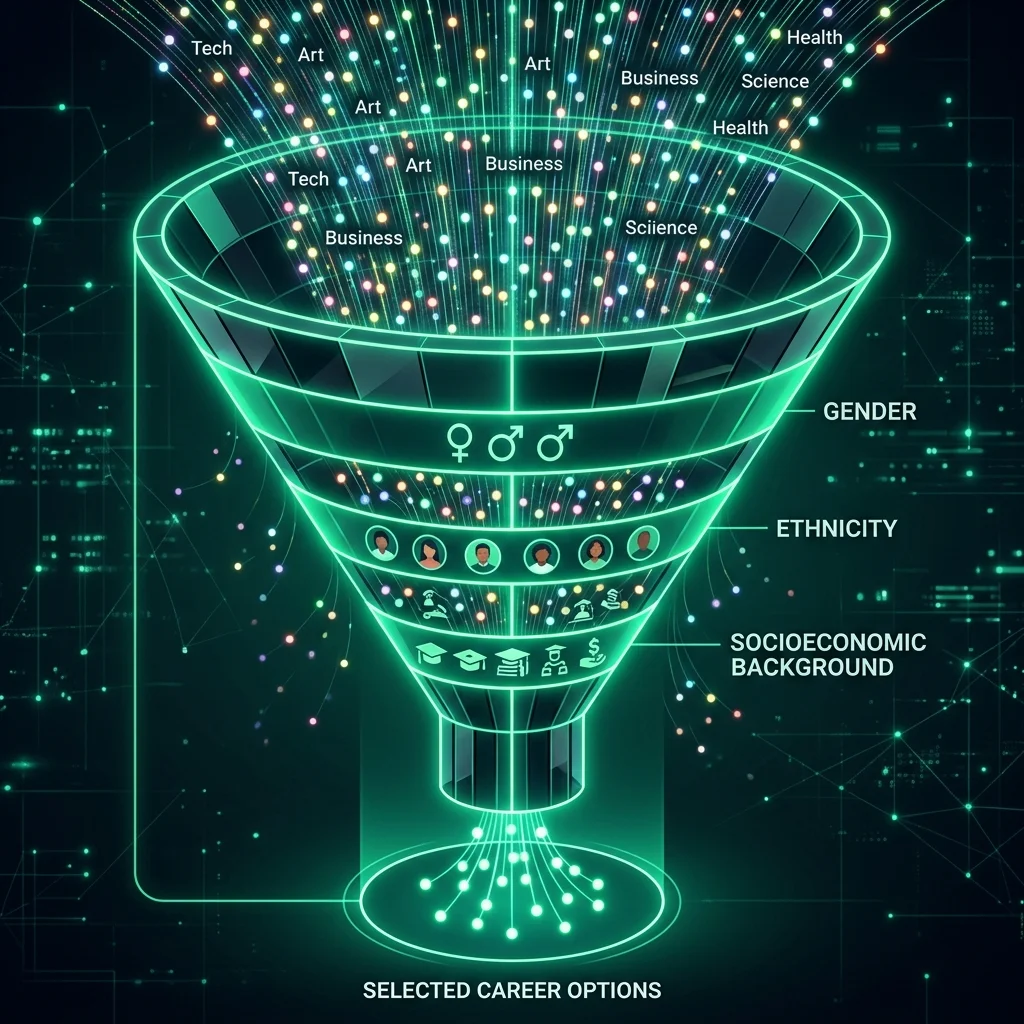
Two mechanisms drive this:
- Circumscription: Entire categories of work get quietly crossed off because they feel too low-status, too difficult, too unfamiliar, or incompatible with how you (or your community) see yourself.
- Compromise: Once the field is narrowed, remaining choices are further adjusted based on real-world access, family expectations, and practical constraints — settling for what's acceptable, not what's optimal.
Why It Matters
This is the mechanism behind the classic case of the academically gifted first-generation student who never applies to medicine, law, or a competitive technical field — not because they lack the ability, but because no one in their environment has modeled that path, and the option was filtered out before conscious evaluation even began. The barrier isn't competence. It's a belief-and-context system quietly narrowing the map.
Comparison: Circumscription vs. Compromise
| Stage | What Happens | Example |
|---|---|---|
| Circumscription | Options eliminated based on social identity, prestige, or perceived fit | Ruling out engineering because "people like me don't do that" |
| Compromise | Remaining options adjusted for access and practicality | Choosing a locally available diploma over an out-of-reach dream program |
Limitations and Modern Interpretation
Gottfredson's theory was developed before the rise of remote work, online credentialing, and global hiring platforms — all of which have loosened some of the geographic and social constraints she described. Access has genuinely expanded. But research since the 2000s continues to find that identity-based circumscription (particularly around gender-typing and prestige) persists strongly, even when practical access improves. Widening access doesn't automatically widen what people let themselves consider.
🎯 Career Next Takeaway
Before you ask "what career is right for me," ask a harder question: "which careers did I eliminate before I ever seriously looked at them — and why?" That list is often more revealing than the list of options you're actively considering. Check out our insights on high paying careers in 2026 to re-evaluate dismissed opportunities.
Chapter 3: The Confidence Gap — Bandura's Social Cognitive Career Theory (SCCT)
What It Is
Even when an option survives social filtering, one more barrier decides whether you actually pursue it: confidence. Social Cognitive Career Theory, built on Albert Bandura's social-cognitive models, holds that career pursuit depends on three forces aligning:

Why It Matters
SCCT explains why raw talent alone doesn't predict who pursues competitive fields. People with strong ability but low self-efficacy routinely avoid paths they'd excel in, held back by environmental barriers: stereotype threat, financial strain, lack of role models, or simply never having been told "you could do this."
📌 Real-World Example
A first-generation university student has the academic profile for medicine, data science, or corporate law. Grades aren't the obstacle. What's missing is a professional network, prior exposure to people in those roles, and a track record of small wins that build belief. Without those, even top-tier ability stalls at the starting line — not from lack of skill, but from an untested belief system.
Building Self-Efficacy: What the Research Supports
Bandura identified four sources of self-efficacy, in order of strength:
Limitations and Modern Interpretation
SCCT is one of the most empirically supported frameworks in vocational psychology, but it's not a guarantee — confidence can be necessary without being sufficient. Structural barriers (cost of training, geographic access, discrimination) still matter independently of belief, and researchers caution against treating confidence-building as a substitute for addressing those structural gaps.
🎯 Career Next Takeaway
If a path feels "not for you," it's worth separating the two possible reasons: a genuine mismatch in interest or aptitude, or an untested belief that hasn't yet had a mastery experience to prove otherwise. Career Next's assessments are designed specifically to help make that distinction.
Chapter 4: Naming the Pattern — Psychological Self-Sabotage in Career Decisions
Circumscription and low self-efficacy don't announce themselves. They show up as everyday thought patterns that feel like reasonable caution but function as self-sabotage:
- Fear of failure — avoiding the attempt so you never have to face the result.
- Impostor syndrome — discounting real competence as luck or fraud.
- Limiting beliefs — treating an old assumption ("I'm not a numbers person") as a permanent fact.
- Identity protection — avoiding a path because succeeding — or failing — would threaten how you see yourself.
- Analysis paralysis — researching endlessly instead of testing a path in the real world.
- Status anxiety — chasing prestige signals instead of genuine fit.
- Social comparison — measuring your timeline against someone else's highlight reel.
- Confirmation bias — only noticing evidence that supports staying put.
- Learned helplessness — assuming effort won't change the outcome, based on past setbacks.
- Fixed mindset — believing ability is static rather than trainable.
📝 Try This: A 5-Minute Self-Audit
Pick one career option you've dismissed in the last two years. Ask:
If your answer to #4 is more generous than your answer to #1, you've likely found a filter, not a fact.
Chapter 5: A Practical Framework for Widening Your Career Map
Identify your hidden filters
List three career paths you've never seriously considered — not because you researched and rejected them, but because they simply never felt available. Write down why they felt unavailable.
Separate fact from filter
For each one, ask whether the barrier is structural (cost, credentials, geography) or perceptual (status, unfamiliarity, "not someone like me").
Run a mastery experience
Choose the lowest-cost way to test the path: a short course, an informational interview, a volunteer project, a trial freelance gig.
Build a vicarious model
Find one real person — even a stranger you follow professionally — who represents the path and shares a similar starting point to yours.
Reset outcome expectations with evidence, not assumption
Look up real salary bands, real day-to-day workloads, and real entry requirements rather than the mental shortcut version. Check our AI Career Roadmap for real-world benchmark data.
Make an evidence-based decision, not a fear-based one
Decide based on what the mastery experience actually showed you — not the anxiety you felt before starting it. Optimize your profile with our Resume Writing Services once you're ready to transition.
📋 Career Planning Worksheet Prompts
- Dismissed Careers: Three careers I dismissed without real evaluation
- Evidence Check: The evidence (if any) behind each dismissal
- Action Step: One small, low-risk test I can run this month
- Role Model: One person whose path I can study or reach out to
Conclusion: You Are the Author, Not Just the Actor
Your career path is shaped by a constant tension between your changing age and identity (Super), the social filters you absorbed before you ever made a formal decision (Gottfredson), and the confidence you have — or haven't yet built — to act (Bandura). Left unexamined, these forces compromise your potential before you even reach the starting line.
The goal isn't to ignore every doubt or chase every dismissed option. It's to make sure the paths you rule out are ruled out on evidence, not on inherited fear. Career Next's career counseling and assessment tools are built specifically to help you separate the two — so the career you eventually choose is one you actually chose, rather than one that was quietly chosen for you by filters you never got to question.
Ready to find out which of your "no's" deserve a second look?
Explore Career Next's career assessment and counseling services to map your real options — not just the ones your filters left behind.
Book a Counseling Session →Frequently Asked Questions (FAQ)
1. Why do I keep rejecting career options that seem like a good fit?
Most people unconsciously eliminate options that feel socially unfamiliar or low-status before ever consciously evaluating them — a process called circumscription (Gottfredson).
2. Is it normal to want a completely different career in my 30s or 40s?
Yes. Donald Super's Life-Span Theory identifies this as the normal Maintenance stage, where priorities shift as your self-concept and life roles evolve.
3. What is Donald Super's Life-Span, Life-Space Theory?
It's a model describing career development as a lifelong process across five stages — growth, exploration, establishment, maintenance, and disengagement — shaped by an evolving self-concept.
4. What are the five stages of Super's career theory?
Growth, Exploration, Establishment, Maintenance, and Disengagement.
5. What is circumscription in career psychology?
Circumscription is the unconscious process of eliminating career options based on perceived social fit, prestige, or gender-typing, rather than ability.
6. What is compromise in Gottfredson's theory?
Compromise is the adjustment of remaining career options based on real-world access, family expectations, and practical constraints, after circumscription has already narrowed the field.
7. What is Social Cognitive Career Theory (SCCT)?
SCCT, based on Albert Bandura's work, explains career pursuit through three factors: self-efficacy, outcome expectations, and personal goals.
8. What is self-efficacy in career decision-making?
Self-efficacy is your belief in your own ability to succeed at a specific task or career path — one of the strongest predictors of whether you pursue that path.
9. Can self-efficacy be built, or is confidence fixed?
Self-efficacy can be built, primarily through mastery experiences (successful direct practice), as well as watching relatable role models succeed.
10. Why do talented people avoid competitive careers?
Often due to low self-efficacy driven by environmental barriers — lack of role models, financial strain, or stereotype threat — not a lack of ability.
11. What is career self-sabotage?
A pattern of thoughts and behaviors — like fear of failure, impostor syndrome, or analysis paralysis — that leads capable people to avoid pursuing well-suited career paths.
12. Is impostor syndrome common in career decision-making?
Yes, it's one of the most common patterns behind career self-sabotage, causing people to discount real competence as luck.
13. How do I know if I dismissed a career for good reasons or out of fear?
Ask whether the barrier is structural (cost, credentials, access) or perceptual (status, unfamiliarity). If you'd encourage a friend with your exact skills to pursue it, the barrier is likely perceptual.
14. What is a "mastery experience" in career psychology?
A direct, successful practice experience — like a short course or trial project — that builds real self-efficacy for a specific career path.
15. How can I test a career path without fully committing?
Try low-risk options like an informational interview, a short online course, a volunteer role, or a small freelance project in that field.
16. Does changing careers mid-life mean I made the wrong choice earlier?
No. Under Super's framework, changing direction as your life roles and self-concept evolve is a normal developmental stage, not a mistake.
17. What's the difference between fixed and growth mindset in career choice?
A fixed mindset treats ability as static ("I'm not a numbers person"), while a growth mindset treats skill as trainable through effort and practice.
18. How does social comparison affect career decisions?
Comparing your timeline to others' curated highlights can distort your sense of what's realistic or "on schedule," fueling unnecessary self-doubt.
19. What role do family expectations play in career choice?
Family expectations are a major factor in the "compromise" stage of Gottfredson's theory, shaping which remaining options feel practically accessible.
20. Can career counseling help identify hidden career filters?
Yes. Structured career assessments and counseling, like those offered by Career Next, are designed to surface options eliminated by unconscious filtering.
21. Is career confidence more important than career skill?
Both matter, but SCCT research shows that without sufficient self-efficacy, even highly skilled people often won't pursue or persist in a path.
22. What is the "confidence gap" in career psychology?
It's the gap between what someone is capable of doing and what they believe they're capable of doing — a key barrier described in SCCT.
23. How do I stop analysis paralysis when choosing a career?
Replace open-ended research with a single small, time-boxed test (like a two-week trial project) that produces real evidence instead of more speculation.
24. What is learned helplessness in a career context?
A pattern where past setbacks lead someone to assume future effort won't change the outcome, even when circumstances have changed.
25. Are career development theories like Super's and Gottfredson's still relevant today?
Yes, though modern researchers note that remote work and online credentialing have expanded practical access, even as identity-based filtering persists.
26. How does Career Next use these psychological frameworks?
Career Next builds its assessments and counseling approach around these evidence-based models to help identify real fit versus inherited filters.
27. What's the first step to overcoming career self-sabotage?
Naming the pattern — running a short self-audit on one dismissed option to check whether the rejection was evidence-based or fear-based.
28. Can prestige-chasing hurt long-term career satisfaction?
Yes — status anxiety can lead people to prioritize prestige signals over genuine fit, which research links to lower long-term career satisfaction.
29. What is career adaptability?
The capacity to adjust career plans and self-concept in response to changing roles, circumstances, and life stages, central to Super's later theoretical work.
30. Where can I get a structured career assessment based on these frameworks?
Career Next offers career assessment and counseling services designed to map real options against psychological and practical fit.